So a few things …

So after this comment, I decided to put a SIMH VAX running 4.3 BSD.  Back in the day, I used to keep a bunch of legacy systems online for the heck of it.  Although I don’t think it ever really took off.. But yeah I figured I should get something back online.

So this time I thought I’d make it somewhat.. different.. So anyways if you feel so inclined go ahead and telnet to

mud.superglobalmegacorp.com

And from there you can create a user account on the mud, and then it’ll create a user in the operating system.


I’ve loaded up a bunch of 3rd party stuff.. And since we are living in the past I managed to get the old news reader ‘rn’ to talk to olduse.net  The first time it runs it’ll complain a bunch but there isn’t much you can do except enjoy the ride.

Lynx is present but.. downloading stuff kind of stalls.

All I ask is you play nice.

I’ve added in the flash telnet app.

Everyone mentioned this yesterday…

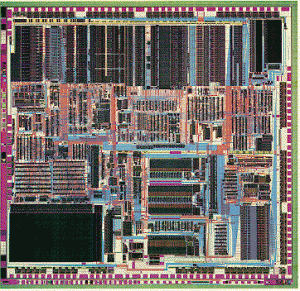
275,000 transistors of awesomeness!

275,000 transistors of awesomeness!

Kind of interesting is that Linux has finally dropped support for the 80386 microprocessor.

The 386 is perhaps one of the top ten things that has changed our world, along with 4.3BSD .

No, really!

The 386 microprocessor was the first CPU by Intel that was single sourced.  This means that Intel, and only Intel would fabricate the 386 processor.  Before this time, Intel had licensed their processors to other companies (Siemens, AMD, Harris, IBM etc) So that if there was some kind of production issue at Intel other companies could manufacture 8086,80186s and 80286s.  However this all changed with the 386, as Intel stopped renewing these agreements with other companies (IBM had a license that included the 386, although they were slow in making their own), so now Intel was in charge of its destiny.

The 386 brought three major changes onto the then champion processor the 286.  The first being a 32bit processor where it could handle larger data sizes than the 16bit 286 & 8086.  The 386 also included a larger memory model, the so called “flat mode” where it could directly address 4GB of combined code+data, while the 286 could address 1GB it was limited to 64kb segments.  Lastly the 386 introduced hardware virtualization, the “v86” mode where the 386 could emulate multiple 8086 processors, allowing people to have multiple ‘virtual machines’ on the desktop.

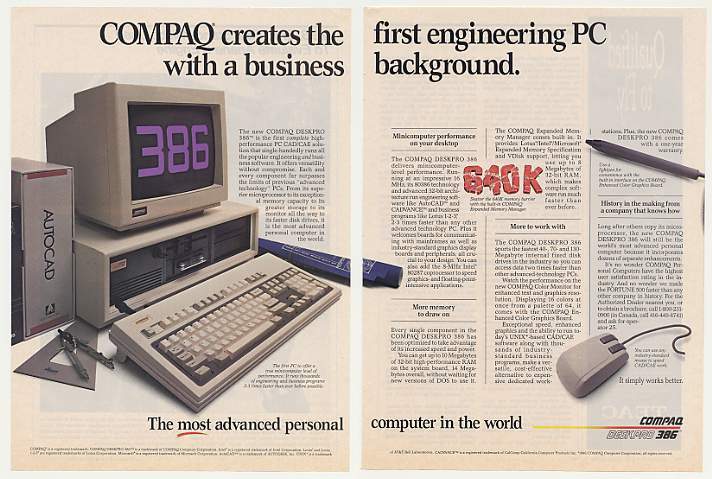
At the time the only consumer grade 32bit processor was the hybrid 32/16 68000 from Motorola.  The 68000 could work with 32bit data, but it was restricted to a 16bit data bus, and only could address 24bits of RAM (16 megabytes).  The 68000 however did not include any kind of memory management unit (MMU) making things like porting UNIX improbable (The SUN-1 workstation included a custom MMU).  Because of the open nature of the IBM PC, clone manufacturers were able to leapfrog IBM, and release 386 based machines before IBM got around to releasing the PS/2 model 80.  It was this that effectively brought 32bit computing to the masses with the Compaq Deskpro.
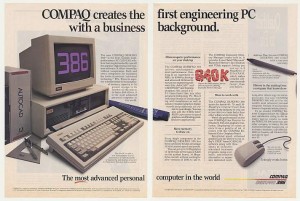
Compaq's 386 Deskpro

Compaq’s 386 Deskpro

The 8086 processor could address 1MB of RAM, with its 20bit address bus.  However to preserve some compatibility with the 8080 processor it was decided that the 8086 (and 8088) CPUs would work with 64kb segments.  This became a massive headache for years as you could not easily contain more than 64kb of data at a time as you would exceed a segment.  Compiler vendors made some workarounds via the large & huge memory models, but porting a program from a 32bit minicomputer (VAX) would prove difficult if it addressed large amounts of memory, and would require a rewrite.  The 286 increased the addressable memory to 16MB, and included a limited MMU, which enabled an address space of 1GB.  However the 286 was flawed in that again the 286 could only work in 64kb segments, and in order to work with large amounts of memory, the processor had to be shifted to protected mode.  However in protected mode, you couldn’t (easily) switch back to real mode.  This needlessly delayed the adoption of protected mode environments, as you would then lose access to the sizable, and growing, library of MS-DOS programs.  Although workarounds were in place for things like OS/2 and DOS Extenders, they were hacks and couldn’t fix the fundamental 64kb issue.  The 386 built upon the 286’s foundation and included a flat memory model where it could address all 4GB of addressable memory in a single segment.  This meant that you could now use massive amounts of data on a consumer grade machine.

For a while the only 32bit environments were Xenix and MS-DOS via DOS Extenders this proved to be a huge liability and effectively stagnated the industry for a long while.  The 286 was a massive determent.  Making things worse was IBMs insistence that the new OS/2 be able to run on the 286, while Microsoft wanted to create OS/2 to run on the 386, and ignore the IBM AT all together. Basically the 286 was created with the assumption that the 8086 wouldn’t be anywhere near as popular as it was.

With the ability to address large amounts of RAM programs only seen on minicomputers and mainframes were finding their way to the microcomputer such as AutoCAD, Oracle, Links 386 Pro, and of course many in house programs where departments now wouldn’t have to pay to run on then ‘big’ minicomputers.  Combined with the 386’s MMU it was also possible to use more memory than was available in the computer, also known as virtual memory.  The 386 made this transparent to the program, only the 32bit environment needed to handle the swapping.

Finally the last big feature of the 386 was v86 mode.  V86 mode in short is a hardware virtualization platform where the 386 can emulate multiple 8086 processors in hardware.  Each virtual machine can get its own isolated memory space, virtual hardware.  Effectively 8086 programs (such as MS-DOS) can run unaltered inside of v86 mode, with the added benefit of being able to run more than one at a time. Windows/386 lead the charge into this new world of virtual machines for the end user.  Before this point, the only wide scale virtual machine environment was the IBM 370 mainframe which could also create virtual mainframes within itself allowing groups to share a single mainframe, but run incompatible software platforms all at the same time.

Thanks to its capabilities the 386 also brought UNIX to the end user.  First with Xenix, then Microport SYSV, and with the removal of AT&T code BSD was able to be released on the 386 via 386 BSD (and later BSDi’s BSD/OS).  During this timeframe the research OS, Minix was extended by Bruce Evans to be able to use some of the 386’s features which then gave rise to Linux.

Thanks to cheap commodity based 32bit computers, and the GNU projects development tools (binutils, gcc, bash) people could then finally realize GNU’s dream of bringing a free and open UNIX like operating system to the masses.

Needless to say, a lot has changed since 1991, and Linux now moving beyond the 386 processor is no surprise.  The rapid adoption of 64bit computing via AMDs extensions, and the new forthcoming 64bit ARM processors do signal the eventuality that one day Linux will even drop support for 32bit processors… Although I wouldn’t expect that for another 20 years.  Even Intel has ceased manufacturing the 386 processor in 2007.

So it is now time to say good bye to the 386 processor.  At the same time thanks to full software emulation, you will never truly be dead. And as always you can check out Linux’s early versions.

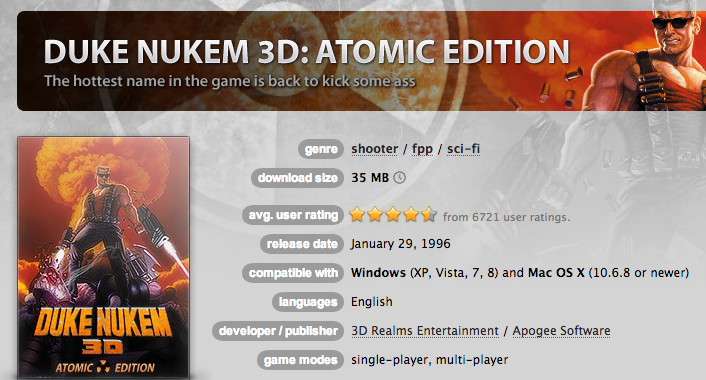
Good Old Games has feee duke nukem 3d!!

Screen Shot 2012-12-13 at 10.26.56 AM

Hail to the king, baby!

There isn’t any excuse not to own one of the greatest games of all time!  But get it while you can!!!!!!  I’m not sure how long this special will last, but what can I say, it’s Duke when Duke was well.. the Duke of Duke Nukem!

The best part about gog, is that their games are DRM free, meaning you don’t really have to run it under DOSBox, you could say run it on Qemu, or even a real PC for the daring!

Some minor work on SIMH

So it’d been a while since I’ve booted it up, and I just went with the 3.8-2 rc2 release (I forget did that version ever get released..?) Anyways since I wanted to run my SIMH instance under a Linux VM..

Soooo I went through some fun to recompile it as a 32bit binary, as the slirp doesn’t work on 64bit machines..

I just built the 11/780 emulator as I wanted to run 4.3 UWisc on my VM (in a VM)..

You can download the build here.

As a reminder the installation instructions for 4.3 BSD Uwisc can be found on gunkies, and all the files needed are on sourceforge.  Also the 4.x BSD if_de.c driver errors out on receiving packets, and I’ve found it easier to just remove the error checking from the driver, and recompile the kernel and just boot that up.

I’m thinking of rebuilding the login process on 4.3 BSD to bring back AberMud, and self service user creation.  Years ago I used to host all kinds of ancient UNIX, and I’d like to bring back at least one..

Frontier Dangerous – update

Part one

Part two

Another update by David Braben about the future of Frontier Dangerous and Chris Robberts of Wing Commander fame.

Interesting take on one project that met its goals, and another that is half way in terms of time and ‘donations’ …  Or more importantly the return of the space combat genre, and of course the ultimate ‘sandbox’ being in the scope of an entire galaxy.

Fun times.

Wyse Unix Lives Again! (sort of)

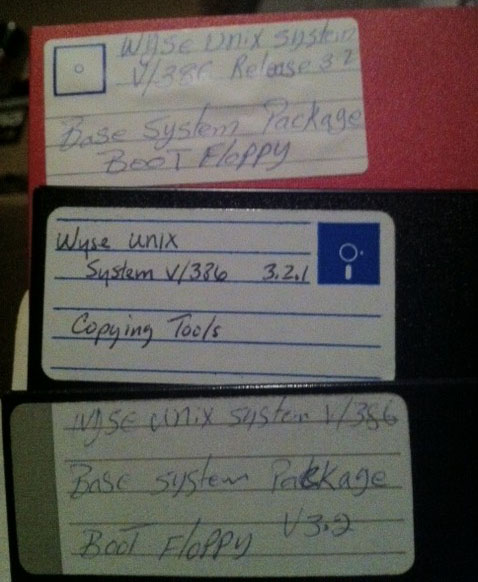
I was waiting for this for a long time. Recently I came in to possession of a box of 5.25″ floppy disks, among them following find:

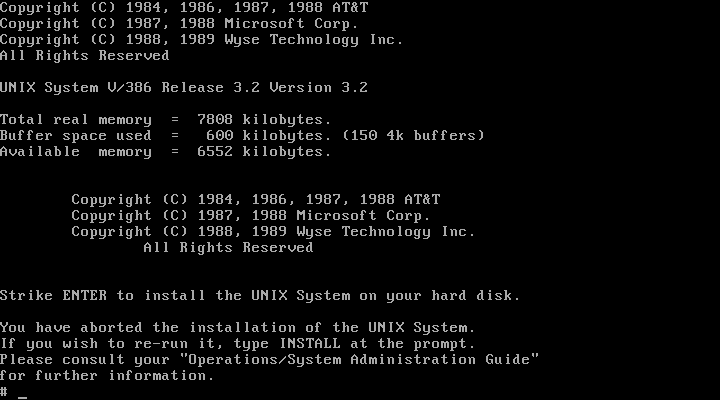
Thanks to efforts of Al Kossow of bitsavers.org and Michal Necasek of OS/2 Museum we got the system to boot on VirtualBox!

Unfortunately we are missing the rest of the system which was distributed either on 15 floppy disks or a tape. If anyone has it, please let me know…

Little bits of information I have found on the web about Wyse Unix:

Interestingly Wyse Unix is a supported os emulation for iBCS.

Update: A full install tape has been found and the system has been fully installed

Compiling Duke Nukem 3D from source

Well most of it anyways….

I mashed in all you need to build it for MS-DOS under MS-DOS here.

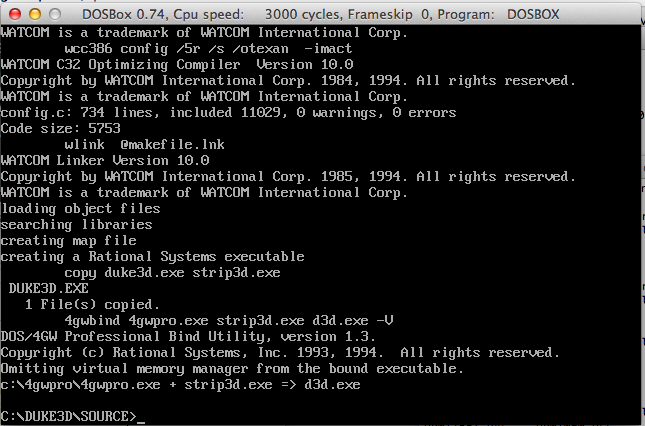
It should be really simple, just run the Watcom C’s setvars, then go into the duke3d\source directory and run ‘wmake’ … All being well it’ll output some exe’s.  I’ve also included the shareware data files so you can test your executables.

Watcom C/C++ 10.0 on DOSBox

Watcom C/C++ 10.0 on DOSBox

Not bad for being under 10Mb, compressed.

Qemu 1.3 released!

You can download the source from qemu.org.  And the changelog is here.

I am on an extended holiday, and I don’t have access to any Windows build machines, or OS X build environment.. So I won’t have a build of this for quite some time (March?)..  Unless I score something in the UK that is.  Or until I find an external disk I can abuse the living daylights out of compiling.  The laptop I’m using is all flash and I don’t think it’d be ‘nice’ to run compile on it for fear of burning it out.

Anyways yeah, new Qemu.

These aren’t my binaries.. but here you go. No idea if they work, either.

Virtualizing Floppy Disk Drive – Part 1

(this is a guest post from Tenox)

I had a really bad weekend associated with floppy drive failures. Either all my floppy disks or all my drives decided to jump the ship. Nothing worked! Worse, I could not buy any “new” floppy disk anywhere. Office Depot still stocks floppies but not in stores and you have to order online and wait. Neither Halted nor Weirdstuff had them as well. Seriously?

A major disaster! Something had to be done to make it future proof. So I went to research floppy drive replacement solutions. And this is what I found. There are several Floppy Disk Emulators on the market.

Here is the list and a little bit of research on every one of them. They do have major differences to be aware of.

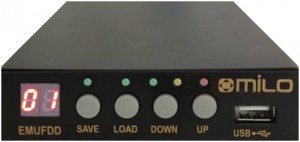
  • EMUFDD – The first one I found. Italian made, intended to be used in industrial machinery. The device is extremely compatible, customizable, feature rich and according to the company, individually installed in each deployment. I bears a lot of interesting features such as Network option. Apart from the high price the device is not intended to be used by hobbyists.

emufdd

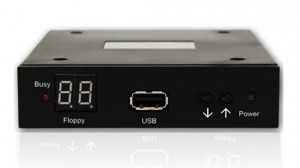
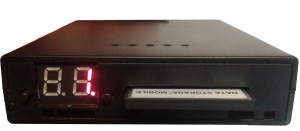
  • Gotek – This one is by an Indian company. Very cheap and you can find it everywhere. It costs about $25 on eBay including shipment. However a major warning: they work by dividing the SD card in to 100 partitions, each size of a single floppy disk and multiplexing them to emulate a floppy disk. Because the partitions are formated with FAT12 the device is not usable for anything else than MS-DOS and Windows. Apparently revision F is capable of storing a single “bootable” or non-MS-DOS disk image. Also they have separate models for 720k, 1.2MB and 1.44MB.  There is a whole army of Gotek clones.

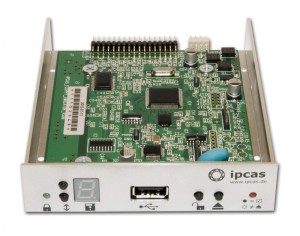
  • IPCAS – This is another clone of Gotek, however worth separate mention and a warning, it costs $300 – ouch!

ipcas

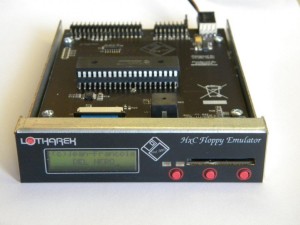
  • HxC – this one was found by claunia. As with most French stuff bit confusing because it has several web sites (one two three). The devices are manufactured in Poland by Lotharek. The price is around $150 and you can buy it on eBay. Feature wise may be the best of all, it definitely supports all the non-PC platforms and even very weird formats. The software naively supports conversion from the notorious IMD and TD0. For some people it will be appealing the HxC is an open source project and you can build it yourself. Certainly it helps to ensure longevity in case of the vendor going out of business. Definitely a winner here.

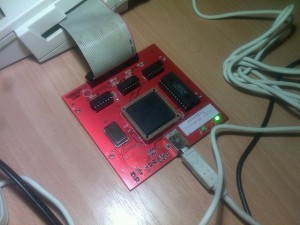
  • HxC USB Version – This is interesting variant that instead of SD card uses a wired USB connection to a host machine.  The main drawback is that it is read only. However you can’t beat it’s $70 price. For this I could probably refit few of my machines and use it for boot only.

hxcusbonly


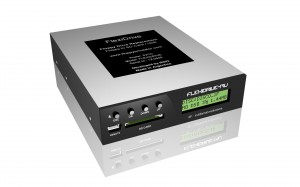
  • FlexiDrive – Made in Argentina. The manufacturer claims to support all floppy disk formats including 8″ disks. SD card or USB based. They are made for industrial machinery and customized firmware for different applications. Cost $385.

FlexiDriveMV-SD


  • DTX200 – from Datex a French company. These are also made for industrial machinery. They maintain a large database of emulated floppy drive types. Interestingly they have video of MicroVAX using their emulator, certainly interesting from retrocomputing point of view! They also make MFM 2 CF hard disk emulator. The price is $495.

dtx200


I have ordered two units for testing: HxC, SD revision F from eBay and Gotek Rev F from the manufacturer. I guess testing of the units will be subject of part 2 of this post. I’m planning to try to install some of the weirdest operating systems with wildest disk formats.

Also as a final note, for more modern computers with USB support there are some more mainstream options. I have used following two professionally:

  • Floppy Emulator in Pendrive / USB Stick. The best success I had so far was zMate pen drive from DaneElec which registers as a floppy drive with the system in addition to regular removable disks. I used it several times for booting, loading Windows storage drivers or saving BIOS diagnostic logs from servers without FDD.
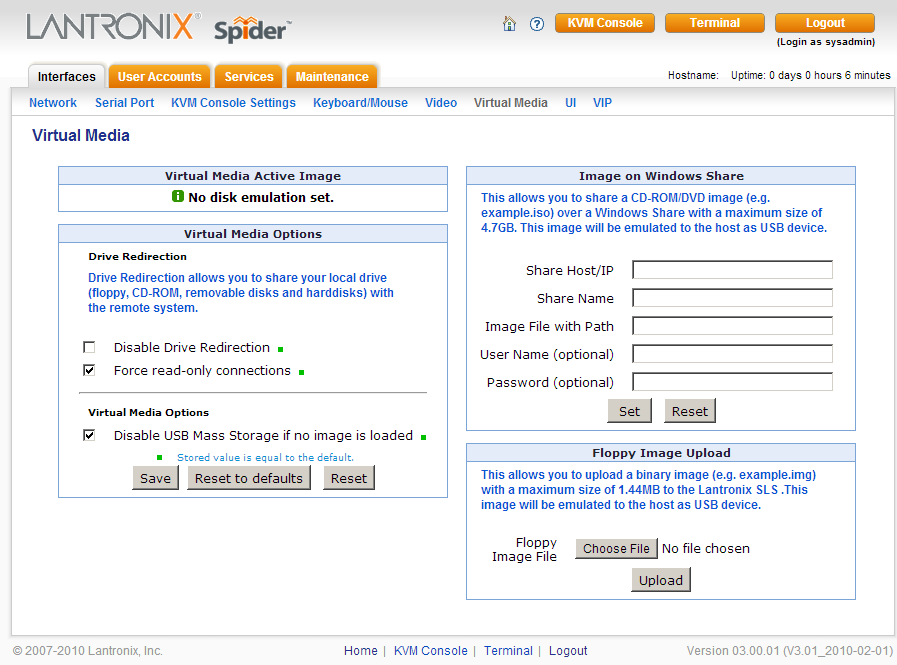
  • Lantronix Spider, which allows you to mount a virtual floppy disk or cdrom image from the viewer machine or SMB share, just as you would using VMware or VirtualBox. Pretty cool.

Updates:

  • Mac Floppy Emu – is specifically designed for Macintosh. However currently it only support 800K. Very promising project and once they add 1.44MB support I will want to retrofit my Macs with this.
  • 1541 Ultimate – Floppy disk emulator for Commodore C64.