Playing old 68000 tracks via sc68

First thing, what makes these tracks from sc68 & sndh unique is that it’s not simple music notes, like MIDI, but rather each track actually includes the native 68000 program to play the track, and it interfaces directly to the hardware. This means that sc68 actually has to emulate enough of the Atari ST & Commodore Amiga to play music. I’ve got to say, it’s pretty impressive!

I’m using WinAmp to act as the player, so this way I just need to download the plugin from sourceforge at the moment the latest is sc68-2.2.1.exe.
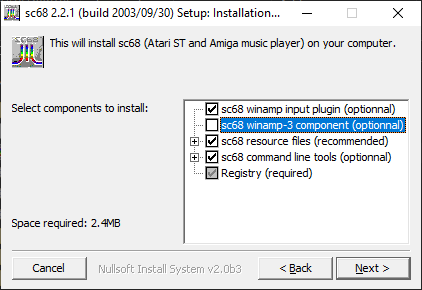
On install I un-selected the winamp-3 component. I’ve tested it with 2.24 and 5.8, both working just fine.

With the plugin installed, you are good to go!

Now where to get music?

As it turns out, the sc68 project has a ‘massive’ 25MB file, sc68files_20031118.tar.gz containing some 1,775 files!

Likewise the SNDH project has downloads on their page
http://sndh.atari.org/download.php that currently sits at 75MB, and has 4,925 files!
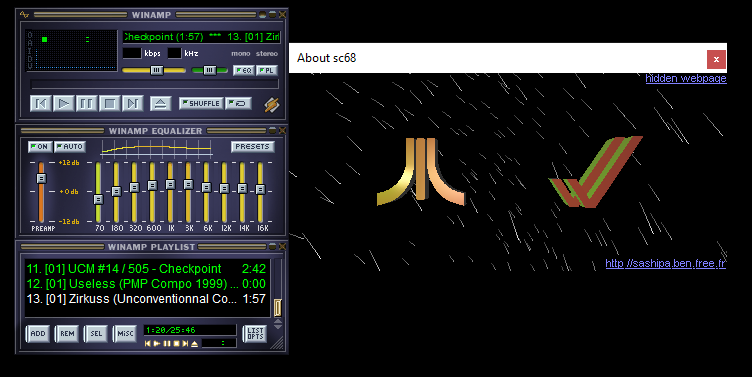
sc68 plugin doing it’s thing

If you look at the code, you can find that it does in fact emulate a 68000 along with peripheral chips and music chips. Just as the SNDH format is 68000 ASM.

So there we go, an obscure music format that actually involves emulation!
French national Internet Referral Unit tries to shutdown archive.org

Count on un-elected technocrats trying to ruin awesome resources with their kanagroo court style operations in their little backwater nonsensical nations.

Good grief.

I should step up my uploads. I did add my NetWare 3.12 disk sets, Citrix Multiuser 2.0 and NeXTSTEP 3.3 CISC stuff.

68000 and i386 C Compiler Version III on Windows

While looking around for simple compilers to see how easy it is to modify their assembly output syntax, I ran across this tiny file, cc68iii3.zip which bills itself as:

This compiler consists of various modules that build up a
front end — these modules are common to all versions of
this compiler — consisting of parser, analyzer and optimizer,
of modules that are specific for the target processor,
namely *68k.c (for the 68000) and *386.c (for the i386),
and of assembly language output modules that are further
dependent on the (syntax of the) target assembler.

Well isn’t that interesting! So instead of doing something 68000 based, I setup the i386-gas compiler, and tried it with MinGW. And amazingly a hello world program worked!

C:\temp\ccc\cc\infocom> type hello.c
void main(){printf("Hello World!\n");}
C:\temp\ccc\cc\infocom> ..\c386gas hello.c hello.s

C:\temp\ccc\cc\infocom> gcc hello.s -o hello

C:\temp\ccc\cc\infocom> hello
Hello World!

C:\temp\ccc\cc\infocom> type hello.s
        .file   "C386GENERATED"
        .version        "C386 V 1.0"
        .optim
c386_compiled.:
        .text
L1:
        .byte 72,101,108,108,111,32,87,111,114,108,100,33
        .byte 10,0
        .align 2
_main:
pushl %ebp
movl %esp,%ebp
pushl $L1
call _printf
popl %ecx
leave
ret
.globl _main
.globl _printf

C:\temp\ccc\cc\infocom>

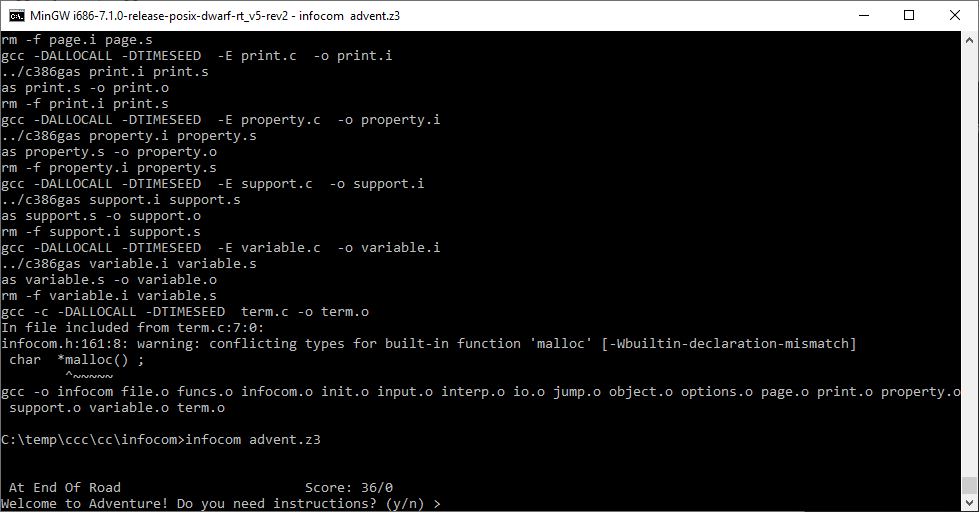
Well that was unexpected, but great! So I thought I’d modify the simple Infocom interpreter to build with this. I came up with this as a block for gnumake to read in a Makefile

%.o:    %.c
        $(CC) $(CFLAGS) -E $<  -o $*.i
        c386gas $*.i $*.s
        as $*.s -o $@
        rm -f $*.i $*.s

The key substitute is $* which is the 'root' of the file being passed in. Although it's lame doing it this way but it works in a nice automatic enough fashion.

The compiler must be K&R only as it doesn't like standard includes, so I built file.c/io.c/term.c using GCC but all the rest were able to be built just fine. And even better it works!

Infocom '87

Although I'd never recommend using something like this in a place that matters. If anything GCC 1.x is probably a better choice, but it's still kind of neat.

Messing with the Monitor

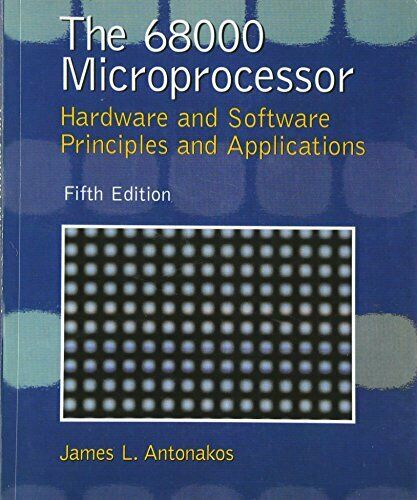
The 68000 Microprocessor (5th Edition) Hardcover Nov 25 2003
by James L. Antonakos (Author)

So I was trapped in the Library for a bit, and spied this book. It’s not every often in 2019 you are going to find books about the 68000, as I’m sure any good library will have removed stuff like this, and have it pulped ages ago. But the amount of current technical books in English here is pretty damned slim to none, so I was all to happy to pickup this book for a week.

The poor thing has been checked out 4 times in the last 15 years. I guess the kids don’t know what they are missing.

Anyways what was interesting in this book is that it has a CD-ROM, and on there is some lesson code from the book, along with an assembler that outputs to S-records of all things, and a small emulator that is meant to be compiled under MS-DOS. It was trivial to isolate the passing of DOS interrupts from Unix/MinGW and get the simulator running on something modern.

In Chapter 11 there is a brief walkthrough on building a board, which sounds like fun although I’m sure in 2019 finding parts will be.. challenging, along with a simple monitor program.

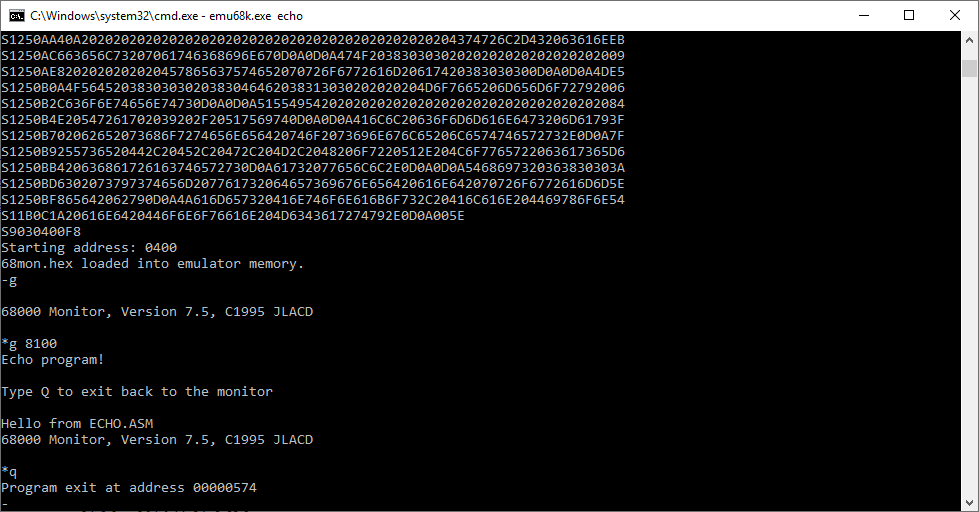
The built in assembler can happily assemble the monitor, but it’s geared for talking to the obsolete hardware as specified in the book. I just made a few small changes to instead have it’s console IO hook to the simulator’s TRAPs and I had the monitor running!

I then took the echo test program, and modified it to run at a higher location in memory, along with exiting via the RTS instruction, so that it will exit when you press Q back to the monitor. Then for the heck of it I further extended the monitor so you can Quit it, and return to the simulator.

Is this useful? I’m pretty sure the answer is absolutely not.

The CD-ROM is tiny, I thought it would be packed with goodies, but it’s 250kb compressed.

The68000MicroprocessorFifthEdition.zip

If anything people using this book will probably have lost the CD-ROM and want the programs.

  • ISBN-10: 0130195618

And my horrible changes here.

Got some new processors!

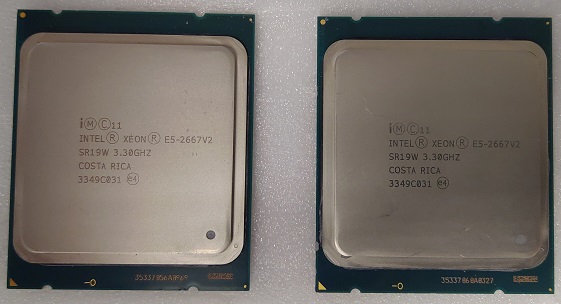
Xeon E5-2667v2

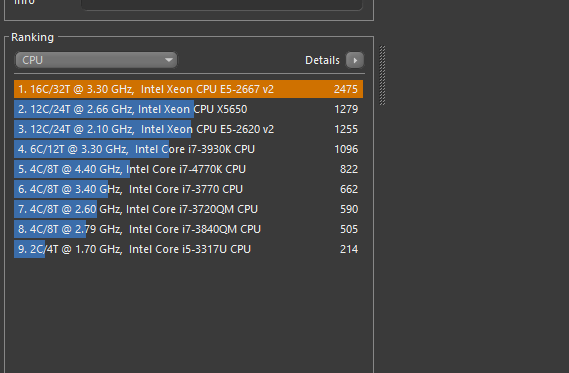
Moved up from the old pair of E5-2620 v2’s to a pair of E5-2667 v2’s. What a big difference from a base clock of 2.1Ghz to 3.3Ghz. And yes, more cores!

2475 Cinebench score

And I can build DOSBox in 3 seconds using Visual C++ 6.0 Ultimate. I guess eventually I’ll get a modern machine, but for now this is pretty damned good. Which reminds me the newer processors for my 2006 Mac Pro should be arriving soon enough.

I couldn’t quite justify the more than double price for the E5-2697 v2 processor, although it has 50% more cores, but with a max clock of 3.5Ghz.

Oh well it’s as good as any update to the Huananzhi X79.

Wasting some cycles on FrontVM

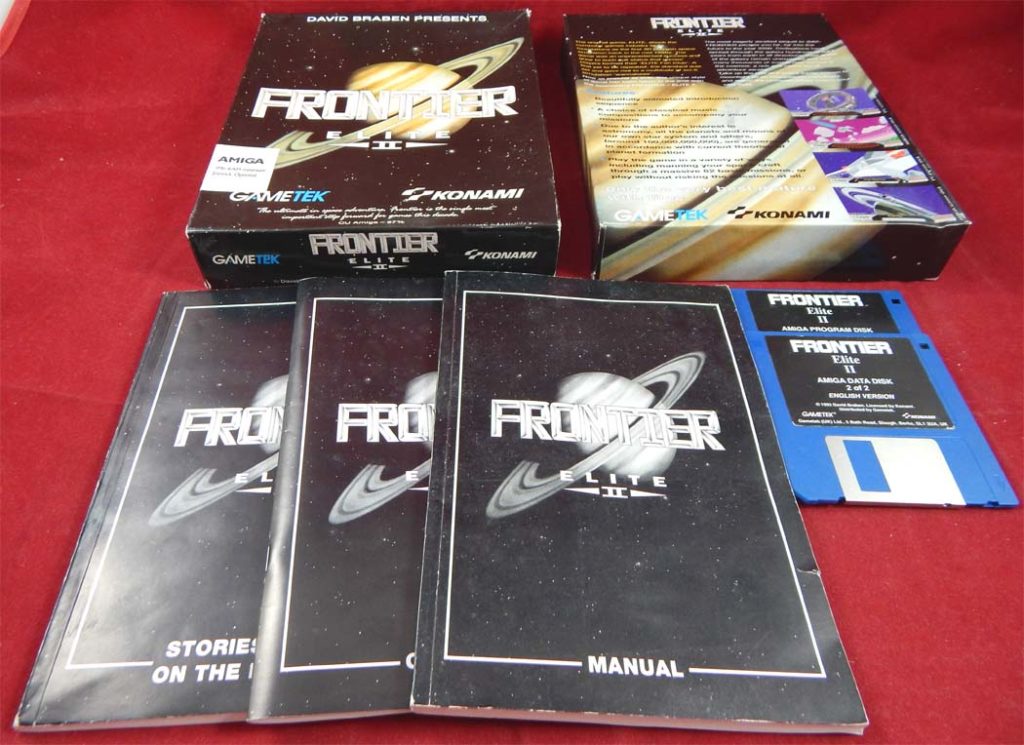
Frontier!

A while ago I had chased FrontVM to moretom.net and found 2 links. One from 2003 which is a dead link, and the 2004 version which was archived by the wayback machine!

It was an interesting build, as it still used 68000 emulation from Hatari/UAE this pre-dates the 68000 to C or i386 ASM. However since it ran (mostly) the original code, it was more ‘feature complete’, although loading save games is broken for some reason (I think the decryption was not disassembled correctly). It was actually a stupid file mode setting. I just updated the source & put out a new binary, testing save games between Linux &Windows.

Anyways, it originally built on Cygwin, so I filled in the missing bits, and have it building on both MinGW & Visual C++

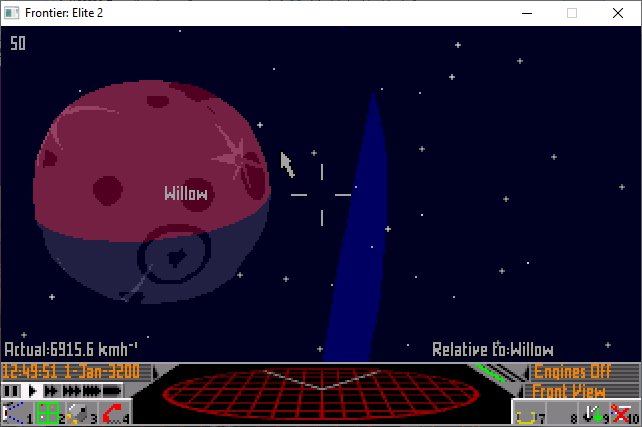
Parked outside Willow in the Ross 154 system

So yeah, it’s Frontier, for the AtariST with the OS & Hardware calls abstracted, still running the 68000 code under emulation. I think it’s an interesting thing, but that’s me.

I put it and the other original versions I found over on sourceforge.net

Download Frontvm

Oddly enough it’s already been downloaded, so go figure.

ReBirth RB-338 v.2.0

I’m not a big sequencer as I’m just terrible when it comes to music. But apparently on Wikipedia Propellerhead had set the download free, although download links now are inoperable.

After a lot of googling around I found it split up on one of those annoying download sites. So I spent the night waiting for stupid timers, training an AI to sport automobiles & intersections (lol redlight camera training), and as a reward I got the download.

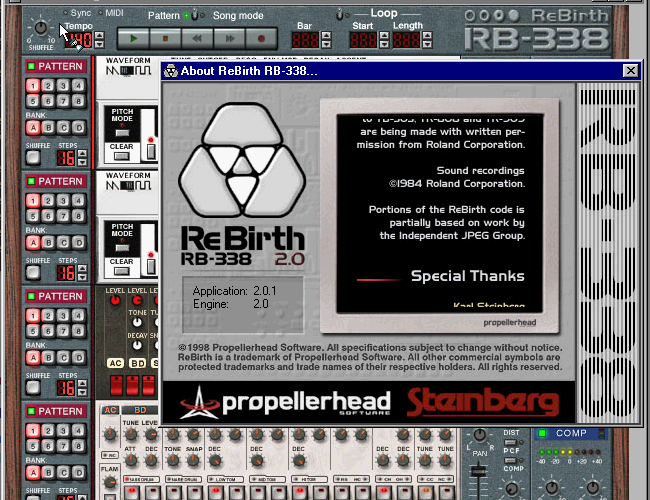
ReBirth on Qemu under Windows 95

I installed it on the floppy version of Windows 95 on Qemu where it needed IE 5.01, Direct X, Winsock 2 & Windows 95 SP1 updates (among others…) and yes it works!

Included in the downloads is some assists so you can run it on Windows 10 x64 if you are so inclined.

Also there is some MacOS X images, although I haven’t tested them. I need to drag my G5 into my office to try it, but it’s getting late, and I want to go home.

I put the download up over on archive.org. You can download it here:

https://archive.org/details/ReBirth-338v2.0

Update:

Since this time my upload to archive.org has been deleted. I was also trying to remove all the google accounts I have and when I changed the email address away from google all my uploads became ‘unknown’ so maybe they are hidden? Anyways over on Wikipeida just use citation #19, and you can download it there.

Early MSDN CD’s on archive.org

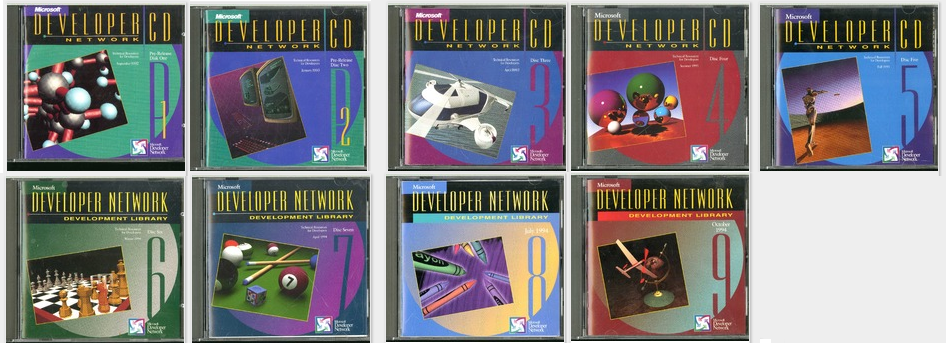
I ran across this, and thought it was cool. These CD’s are getting harder and harder to find, and unless you want the old physical disks, getting ISO images is, of course the next best thing.

Granted these disks replaced the much older Microsoft Programmer’s Library. The new CD’s use a Windows based search & interface program removing the clunky old MS-DOS program that made it feel like trying to view the world through a straw. (Although the up side of the MS-DOS version is that you could easily dump the video RAM and save the contents to plain text).

And in this brave new post Windows 3.0 centric world of Microsoft just about everything regarding OS/2 was dumped, and the seeding of Win32 via Windows NT had started.

Naturally after winning this war, Microsoft withdrew many low end products and just couldn’t compete with the tidalwave that was GNU/Linux.

At any rate for the curious kids down the road that want to see what all the fuss was with Win16, and how Windows 3.0 had changed the landscape removing the force of IBM it’s worth a look.