I guess the bad power supplies really are quite bad.
So now I have a project instead of something to do something. Â I guess it doesn’t matter, I don’t have a keyboard, video cable, diskettes or anything.
I guess the bad power supplies really are quite bad.
So now I have a project instead of something to do something. Â I guess it doesn’t matter, I don’t have a keyboard, video cable, diskettes or anything.
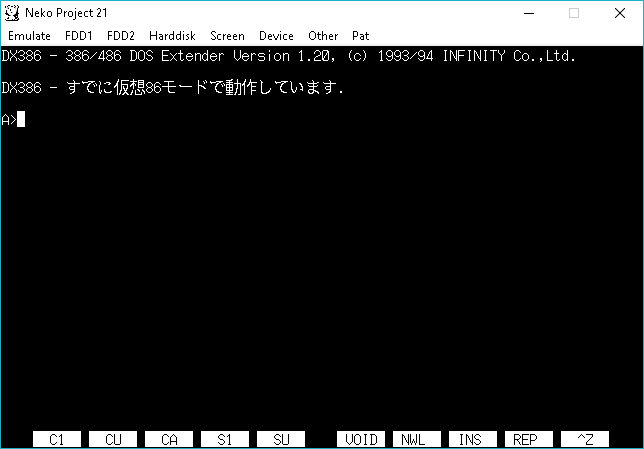
So the first thing you’ll need is Neko Project II. It can be a little hard to track down downloads, but there is a whole slew of them here:
http://ux.getuploader.com/emu/index/1/date/desc the site has since moved to here:
http://nenecchi.html.xdomain.jp/
https://simk98.github.io/np21w/download.html (it moved again)
So for now this link, is the latest build, which was last updated on
Extract that, and rn np21nt.exe
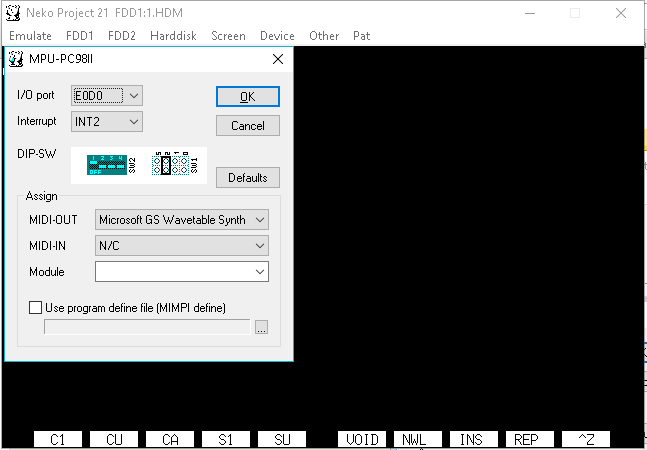
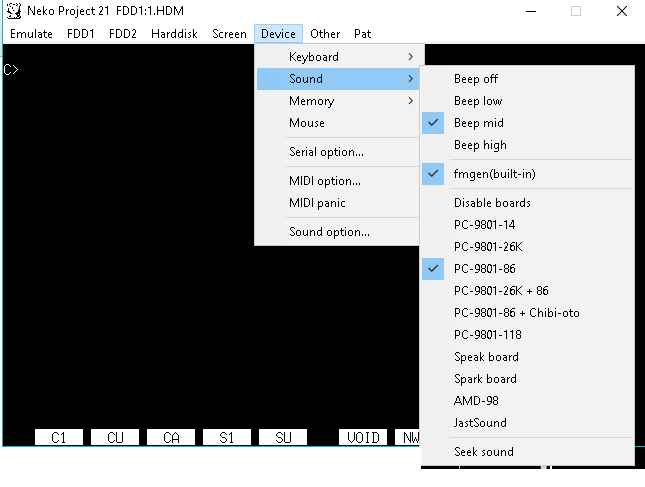
You’ll want to configure the sound.
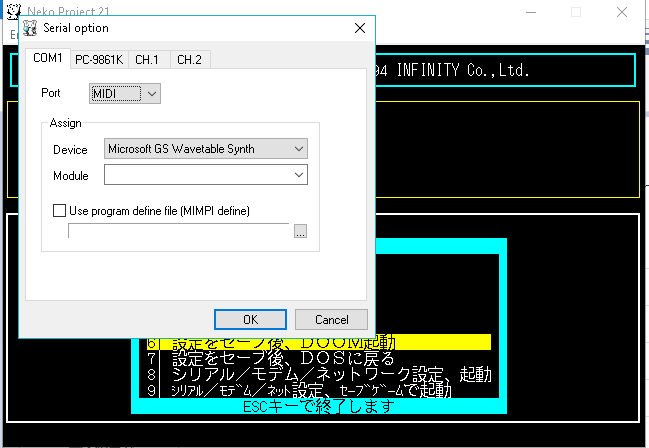
If you choose to use the MIDI you’ll have to map them to a MIDI-OUT port, and I used the default Microsoft GS Wavetable. Â Of course you could use MUNT, or any other MIDI mapper or port. Â Also you may want to setup the serial port MIDI as a backup plan.
The sound effect settings work best for the PC-9801-86 audio board.
I’ll save installing MS-DOS, and installing DooM for another fun episode, but to configure DooM.
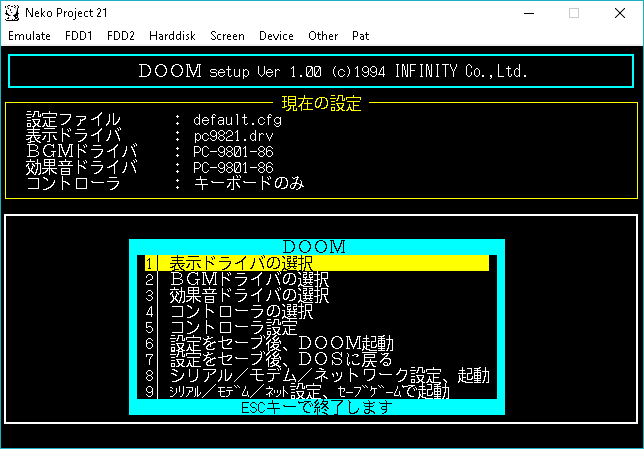
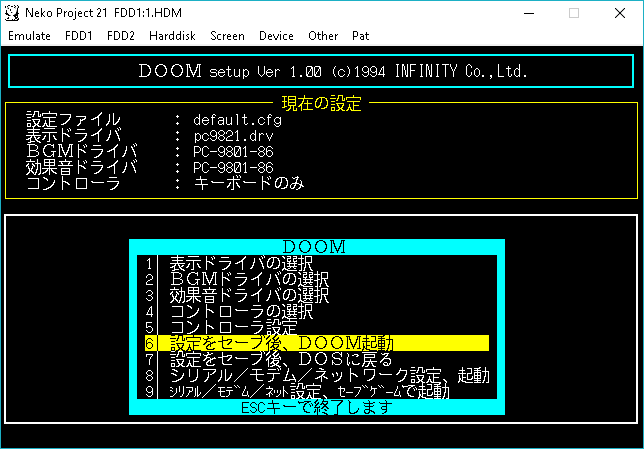
Run setup.exe to setup DooM!
The menu is simply:
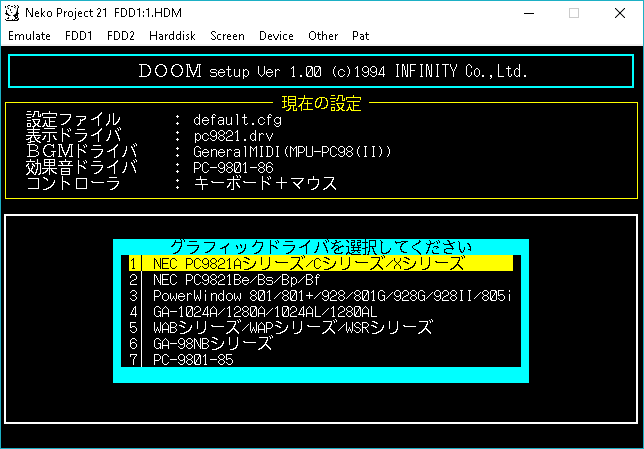
The PC9821A driver works best from what I’ve done in my limited testing. I guess if you had a different emulator, or a real PC-98 you’ll get more out of this.
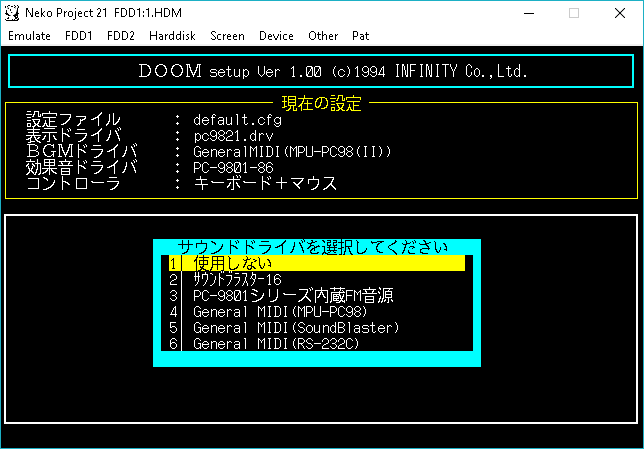
Next is the BGM or music
You really have 2 options here, #3 for the PC9801 driver which uses the YM2608 chip. Or the General MIDI either option 4 or 6. I didn’t notice any difference between the two of them, they both sound kinda slow, but workable.
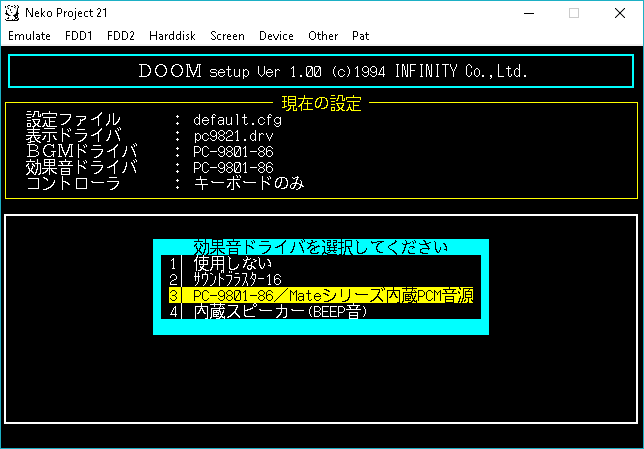
Now for the audio board, select the PC-98
The PC-9801-86 is what you want here. Now with either a 100% PC-9801-86 config, or a 50/50 of the MIDI/PC-9801-86 we are ready to run DooM! Selection option 6 and away we go!
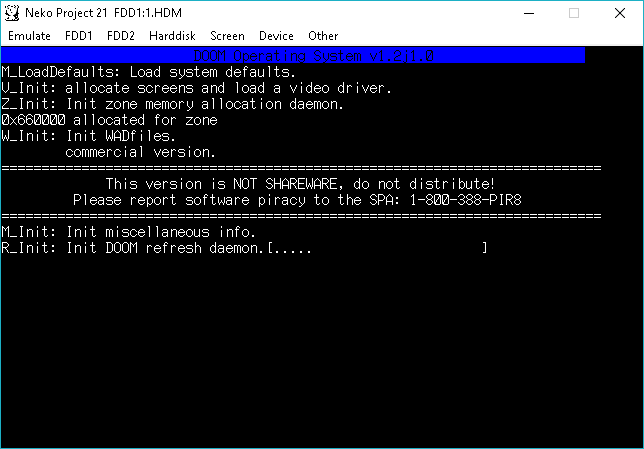
And all being well you’ll get the start of DooM!
Otherwise, you’ll get this fun error:
In this case I had emm386.sys in my config.sys which conflicts with the dos extender DX386.
Personally, I find it easier to boot off the #1 install diskette which will automatically start DooM!
If you are feeling brave, listen!
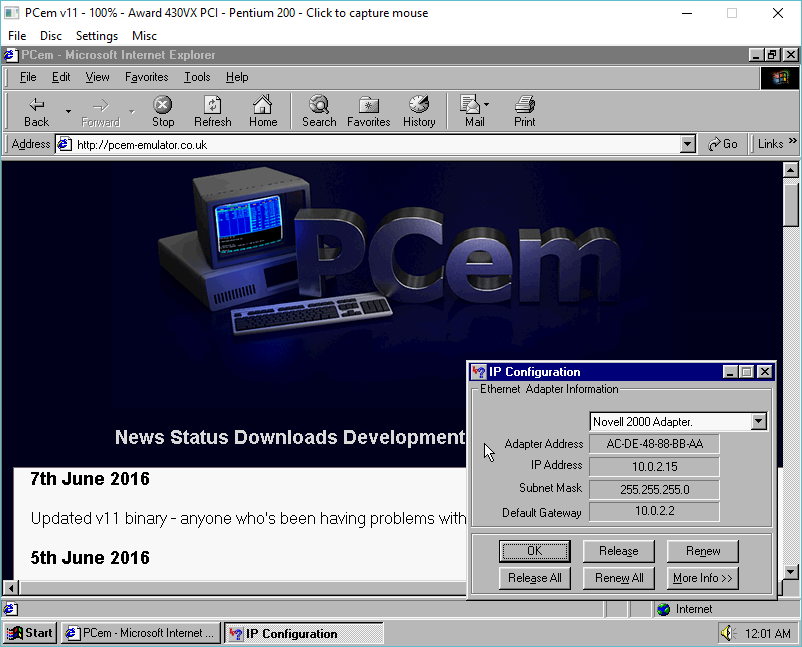
injecting networking was no more difficult than it was in version 10. Â It’s only a few changes to pc.c, if you look at the USENETWORKING define you’ll see them. Â The best notes are on the forum.
I haven’t changed or improved anything it still requires manual configuration.
Downloads are available on my site as pcem_v11_networking.7z.  You’ll have to defeat the password protection, as always.  I included the source, it ought to be trivial to rebuild.
*For anyone using an old version the ‘nvr’ directory is missing, so PC-em is unable to create new non volatile ram save files, meaning you always loose your BIOS settings. Â Sorry I missed that one.
Anyways, I don’t work for them, I have no affiliate, no ads etc, but I think this is interesting enough to pass on.
WinUAE 3.3.0 (06.06.2016) ========================= New features: - New optional "indirect" UAE expansion trap system, fully compatible with OS 4.x, virtual memory and some debugging programs. - PC Bridgeboard disk drive raw image support. (ipf, ext adf,...) - Monochrome video out emulation, including A1000 color/mono video out software control (BPLCON0 COLOR bit). - Dark palette fix option to correct colors of badly ported Atari ST games (Midnight Resistance etc..) - Official CSPPC/BPPC flash updater can be used to install full ROM image without having existing ROM image file. - Custom input events can execute Amiga-side commands and scripts. - Windows clipboard to emulated Amiga keyboard paste support. - Variable refresh rate optimized vsync mode (G-Sync/FreeSync). - Black frame injection is supported in variable refresh modes. - IVS Trumpcard Pro/GrandSlam SCSI emulation. OS4.x supported UAE expansions: - Directory harddrives, including on the fly insertion/removal. - CDFS CD mounting. - Clipboard sharing. - uaegfx RTG. - uaehf.device hardfiles. - Virtual mouse driver/magic mouse/tablet mode. - uaenet.device. - uaeserial.device. - uaescsi.device. - uae.resource. - uaenative.library. Thanks to all who donated. NOTE: Performance is not (and can't be) as fast as with m68k AmigaOS, especially with directory harddrives, due to slower, much more complex UAE to/from native code context switch trap system. Updates: - Game Ports panel input customization is finally very intuitive. - On the fly input device insertion/removal improvements. - Many input device handling updates and fixes. - Faster screenshot/capture in after filtering mode. - Continuous screenshot mode. - CD32 Akiko chip low level emulation compatibility improved. - Nero .nrg CD image support. Bug fixes: - Hardware RTG emulation rendered same frame twice in some situations causing slow performance. - Amithlon partition type (0x78/0x30) support works again. - Some storage devices failed to mount as a harddrive. - AGA subpixel scrolling glitches. - Miscellaneous custom chipset emulation fixes. - AGA mode HAM6 colors were not 100% accurate. - Some programmed custom chipset display modes crashed. - Direct3D mode DirectX9 not installed warning corrupted memory. - Fullscreen + paused + enter GUI: GUI was invisible. - Display panel gamma value calculation fixed. - CDFS automount didn't mount CDs with empty label.
Download WinUAE 3.3.0 [installer] [zip-archive] [zip-archive, 64-bit version] [PPC core plugin, WinUAE 3.0 or later]
Download WinUAE extension packages [1.5.1+ Direct3D Pixel Shader filters](Latest DirectX required) [Improved drive sounds] [Portaudio library]
Download translation DLL: [Default (English)]
Sigh so much I wanted to do with this….
It’s a x68000 emulator. Â What made me jump was looking was the license on github:
/*
* Copyright (c) 2003 NONAKA Kimihiro
* All rights reserved.
*
* Redistribution and use in source and binary forms, with or without
* modification, are permitted provided that the following conditions
* are met:
* 1. Redistributions of source code must retain the above copyright
* notice, this list of conditions and the following disclaimer.
* 2. Redistributions in binary form must reproduce the above copyright
* notice, this list of conditions and the following disclaimer in the
* documentation and/or other materials provided with the distribution.
* 3. All advertising materials mentioning features or use of this software
* must display the following acknowledgment:
* This product includes software developed by NONAKA Kimihiro.
* 4. The name of the author may not be used to endorse or promote products
* derived from this software without specific prior written permission.
*
* THIS SOFTWARE IS PROVIDED BY THE AUTHOR “AS IS” AND ANY EXPRESS OR
* IMPLIED WARRANTIES, INCLUDING, BUT NOT LIMITED TO, THE IMPLIED WARRANTIES
* OF MERCHANTABILITY AND FITNESS FOR A PARTICULAR PURPOSE ARE DISCLAIMED.
* IN NO EVENT SHALL THE AUTHOR BE LIABLE FOR ANY DIRECT, INDIRECT,
* INCIDENTAL, SPECIAL, EXEMPLARY, OR CONSEQUENTIAL DAMAGES (INCLUDING, BUT
* NOT LIMITED TO, PROCUREMENT OF SUBSTITUTE GOODS OR SERVICES; LOSS OF USE,
* DATA, OR PROFITS; OR BUSINESS INTERRUPTION) HOWEVER CAUSED AND ON ANY
* THEORY OF LIABILITY, WHETHER IN CONTRACT, STRICT LIABILITY, OR TORT
* (INCLUDING NEGLIGENCE OR OTHERWISE) ARISING IN ANY WAY OUT OF THE USE OF
* THIS SOFTWARE, EVEN IF ADVISED OF THE POSSIBILITY OF SUCH DAMAGE.
*/
Which is the normal BSD license… But the other v0.65 source code makes no mention.  Oh well, I guess it’s really not BSD licensed then?  I need to keep banging on system16 anyways…
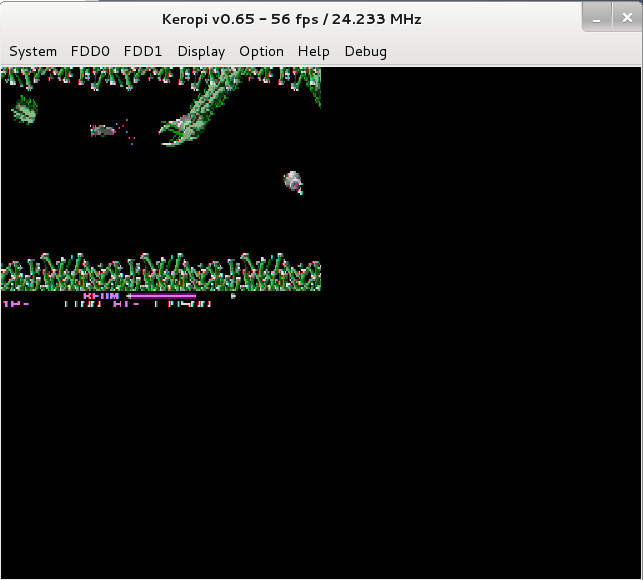
But in this case the graphics are for GTK of all things, and are hard coded to only run on 15/16bit displays.  SO by removing the requirement I got it to display something.  Also the IPL roms need to be in $HOME/.keropi .  It plays R-Type well enough, but at the same time so does MAME.
I haven’t had time to follow it, but great news!
PCem v11 released. Changes from v10.1 :
Thanks to Battler, SA1988, leilei, Greatpsycho, John Elliott, RichardG867, ecksemmess and cooprocks123e for contributions towards this release.
It’s pretty cool actually when you think that it was written in BASIC.
Pretty impressive actually. Â It reminds me of Apollo 18.
Checkout the site here.
While looking at some old picture of a 3B2, I remembered in college we used to use this ‘fine’ system for it’s Writer’s Workbench which revolved around the programs style & diction.
I thought it’d be interesting to see if I could track down the source, however the sources seem to have been part of the AT&T DWB package, and were not included in any of the seemingly numerous available Unix sources available on TUHS.  But thanks to this post on the TUHS mailing list, I saw this:
I know about style and diction which was shipped with BSD4.1 which (again wooly memory) was an early subset of the whole wwb package.
Going with this, I pulled out the recently unearthed images on bitsavers of 4.1_BSD_19810710, and in the tape images sure was the source!  The only date in there is from 1979!
Deroff Version 2.0 Â Â 29 December 1979
Which for a 1981 tape sure would be in the same light. Â So with some fun playing with the makefiles, I had it running on Debian 8 x64! Â So with a little bit of kicking I have it running on Windows via MinGW.
So for a fun example, I though I’d take Bill Gate’s forward on Inside OS/2:
OS/2 is destined to be a very important piece of software. During the
next 10 years, millions of programmers and users will utilize this system.
From time to time they will come across a feature or a limitation and
wonder why it's there. The best way for them to understand the overall
philosophy of the system will be to read this book. Gordon Letwin is
Microsoft's architect for OS/2. In his very clear and sometimes humorous
way, Gordon has laid out in this book why he included what he did and why
he didn't include other things.
The very first generation of microcomputers were 8-bit machines, such
as the Commodore Pet, the TRS-80, the Apple II, and the CPM 80 based
machines. Built into almost all of them was Microsoft's BASIC Interpreter.
I met Gordon Letwin when I went to visit Heath's personal computer group
(now part of Zenith). Gordon had written his own BASIC as well as an
operating system for the Heath system, and he wasn't too happy that his
management was considering buying someone else's. In a group of about 15
people, he bluntly pointed out the limitations of my BASIC versus his.
After Heath licensed my BASIC, I convinced Gordon that Microsoft was the
place to be if you wanted your great software to be popular, and so he
became one of Microsoft's first 10 programmers. His first project was to
single-handedly write a compiler for Microsoft BASIC. He put a sign on his
door that read
Do not disturb, feed, poke, tease...the animal
and in 5 months wrote a superb compiler that is still the basis for all our
BASIC compilers. Unlike the code that a lot of superstar programmers write,
Gordon's source code is a model of readability and includes precise
explanations of algorithms and why they were chosen.
When the Intel 80286 came along, with its protected mode completely
separate from its compatible real mode, we had no idea how we were going to
get at its new capabilities. In fact, we had given up until Gordon came up
with the patented idea described in this book that has been referred to as
"turning the car off and on at 60 MPH." When we first explained the idea to
Intel and many of its customers, they were sure it wouldn't work. Even
Gordon wasn't positive it would work until he wrote some test programs that
proved it did.
Gordon's role as an operating systems architect is to overview our
designs and approaches and make sure they are as simple and as elegant as
possible. Part of this job includes reviewing people's code. Most
programmers enjoy having Gordon look over their code and point out how it
could be improved and simplified. A lot of programs end up about half as
big after Gordon has explained a better way to write them. Gordon doesn't
mince words, however, so in at least one case a particularly sensitive
programmer burst into tears after reading his commentary. Gordon isn't
content to just look over other people's code. When a particular project
looks very difficult, he dives in. Currently, Gordon has decided to
personally write most of our new file system, which will be dramatically
faster than our present one. On a recent "vacation" he wrote more than 50
pages of source code.
This is Gordon's debut as a book author, and like any good designer he
has already imagined what bad reviews might say. I think this book is both
fun and important. I hope you enjoy it as much as I have.
First we run it through style which will give the overall report on the text.
D:\diction\bin>style.cmd forward.txt
readability grades:
(Kincaid) 9.1 (auto) 9.2 (Coleman-Liau) 8.8 (Flesch) 8.5 (64.8)
sentence info:
no. sent 31 no. wds 607
av sent leng 19.6 av word leng 4.43
no. questions 0 no. imperatives 0
no. nonfunc wds 338 55.7% av leng 5.58
short sent (<15) 35% (11) long sent (>30) 13% (4)
longest sent 35 wds at sent 14; shortest sent 7 wds at sent 5
sentence types:
simple 39% (12) complex 32% (10)
compound 3% (1) compound-complex 26% (8)
word usage:
verb types as % of total verbs
tobe 33% (26) aux 22% (17) inf 13% (10)
passives as % of non-inf verbs 6% (4)
types as % of total
prep 8.6% (52) conj 4.1% (25) adv 7.1% (43)
noun 23.9% (145) adj 14.7% (89) pron 8.4% (51)
nominalizations 0 % (3)
sentence beginnings:
subject opener: noun (6) pron (5) pos (2) adj (3) art (3) tot 61%
prep 19% (6) adv 6% (2)
verb 0% (0) sub_conj 13% (4) conj 0% (0)
expletives 0% (0)
So that places it on the grade 9 level, average readability.
Now let’s see about usage errors with diction!
D:\diction\bin>diction forward.txt
os 2 is destined to be a[ very ]important piece of software.
during the next 10 years millions of programmers and users will[ utilize]
this system.
the best way for them to understand the[ overall ] philosophy of the system
will be to read this book.
in his[ very ]clear and sometimes humorous way gordon has laid out in this
book why he included what he did and why he didn t include other things.
the[ very ]first generation of microcomputers were 8 bit machines
such as the commodore pet the trs 80 the apple ii and the cpm 80 based
machines.
built into almost[ all of ]them was microsoft s basic interpreter.
unlike the code that[ a lot of ]superstar programmers write gordon s source
code is a model of readability and includes precise explanations of algorithms
and why they were chosen.
[ in fact ] we had given up until gordon came up with the patented idea described
in this book that has been referred to as turning the car off and on at
60 mph.
[ a lot of ]programs[ end up ]about half as big after gordon has explained
a better way to write them.
when a particular project looks[ very ]difficult he dives in.
number of sentences 34 number of hits 11
As you can see, Bill likes very, very much.
Explain can give you examples of what to use instead, so how about ‘a lot of’?
D:\diction\bin>bash explain phrase? a lot of use "many" for "a lot of" phrase?
Explain is a sed script, so in this case I’m using MinGW’s MSYS environment to run the script.
I don’t think much of anyone will care about text processing utilities from the 1970’s in 2016 (and beyond) but for anyone else who is bored, or found out about this by mistake, here you go!
You’ll get a 404 page, just read the error page for the password.

Years and years ago I had bought this copy of Language Systems Fortran for MacOS with the intention of using my Quadra to build Dungeon for MacOS. Â Except I couldn’t figure out the first thing about MPW, and life was always busy and I never did figure it out. Â Well after getting GCC to compile something on MacOS, I thought I’d dig up some images I made of the disks, and without the benefit of having the manuals anymore see if I could figure it out.
And much to my amazement it compiled without any real issues. Â All the EOF markers in the files had to be fixed up, and gdt.f for some reason was mangled at the end, but it was trivial to repair. Â I didn’t bother trying to integrate the gettime call, so the clock and any clock events don’t work correctly. Â I guess I should make the seconds increment by 15 between calls, or something. Â Oh well I don’t think anyone will really care. Â I compiled it for the 68020 with 68881 hooks, although I doubt it even makes any calls. Â It runs for me.
If anyone cares, the binary is here:dungeon-2.5.6-m68k-MacOS.sit
As always, you’ll have to read the 404 screen to get the download.