Sometimes it’s just worth taking a day off and getting out.
While out, I found this kite lying by the garbage in a bag. Fully assembled, and with a fresh spool. It seemed like a sad loss of a kite. It was a cloudy day, but nice high winds. So I took it out to fly.
This picture is where it just got to the point where it was high enough to get enough lift to fly on it’s own. The winds were so good, that I was able to unspool the kite, and get it high enough that you barely could see it.
Much like retro-computing there can always be senseless fun in other people’s garbage.
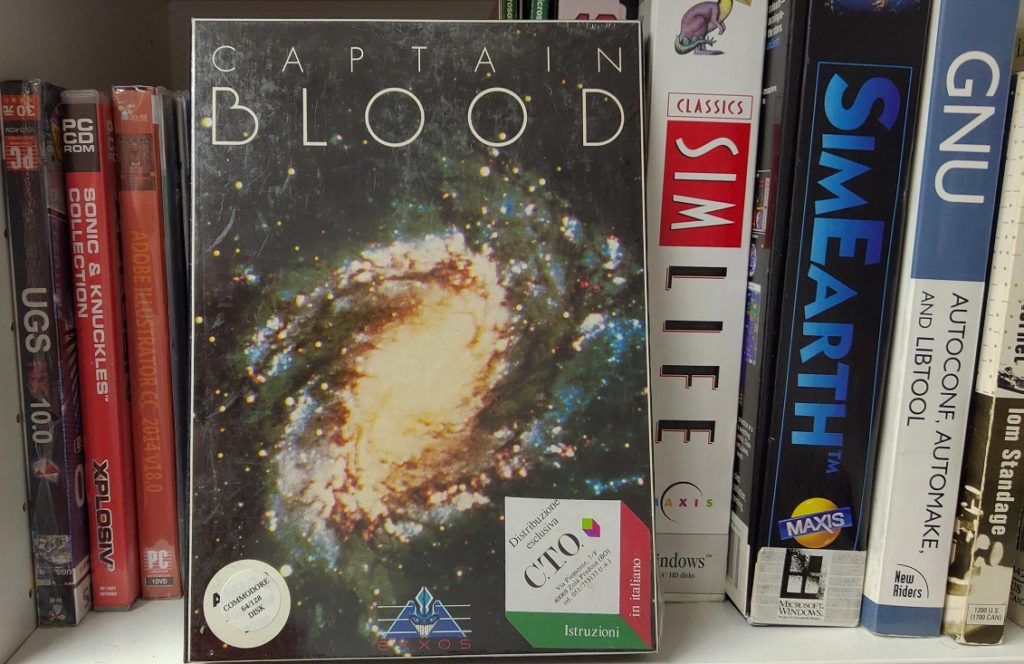
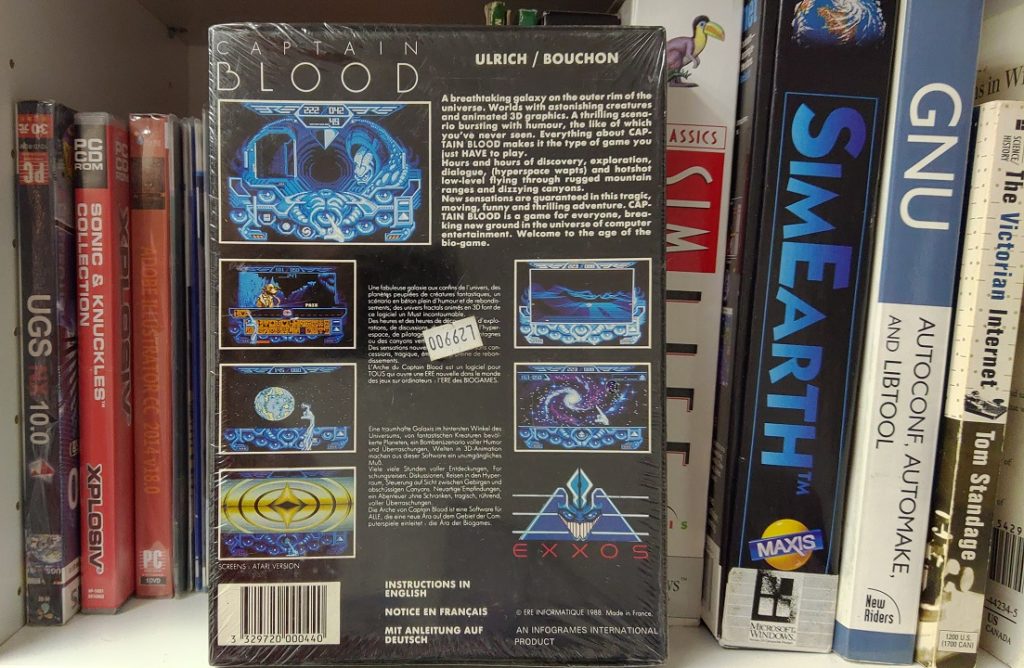
It’s from Italy, and apparently was originally boxed for the Amiga, and then re-purposed for the Commodore 64. Compared to American ‘big box’ releases of the era, it’s a tiny box. A few of my SIM games are behind, it along with some DVD cases I picked up in China.
29,900 Lira?
I guess the price makes sense if the final exchange rate of the Lira was 1,276:1 USD back in the winter of 1988, making this copy $23 USD. Although I’m pretty sure when I bought mine I had to pay some $40 CAD. Yay.
I don’t think Captain blood really made it to tape, so it’s really not all that surprising then that this disk version has sat in it’s box for so long. Every time I’d seen anything Commodore in Italy or even the EU it was always tape. Such a shame too, as that means no Infocom.
Normally I wouldn’t even bother with something like this, as I have images for every release there was, but this is a sealed copy. Apparently there is a poster inside of many of the European releases. Although I’m unsure if this one does. It’s been sealed for some 31 years so far. Although it’d make a great poster to frame.
I’ve been trying to clean up the Mega ST I have, but it appears to be dead. Nothing seems to be on the video out, and it’s not lighting up or spinning the disk. I guess this means I’ll need some kind of logic probe. Well after I find my volt meter to see if I’m getting the correct voltage. The Atari doesn’t seem so complicated so I guess an ATX power supply can be rigged to output the 5/12v.
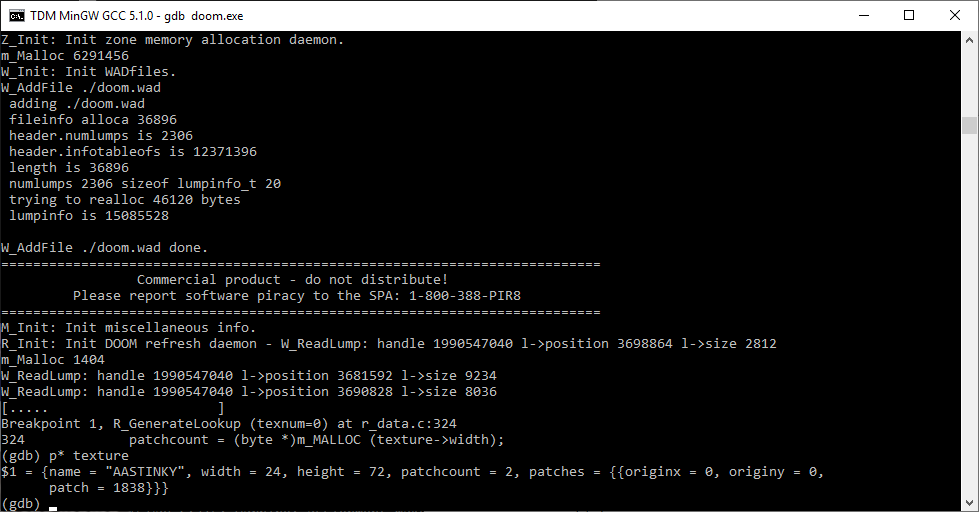
After tracking down the library source, I’ve focused my GCC stuff on version 1.30 as it’s the same base version that was used in the x68000 port, and didn’t suffer from any struct packing that I remember. And of course the never ending stress of day jobs.
On the i386 a texture info lump loads up just fine. However on a big endian G5…
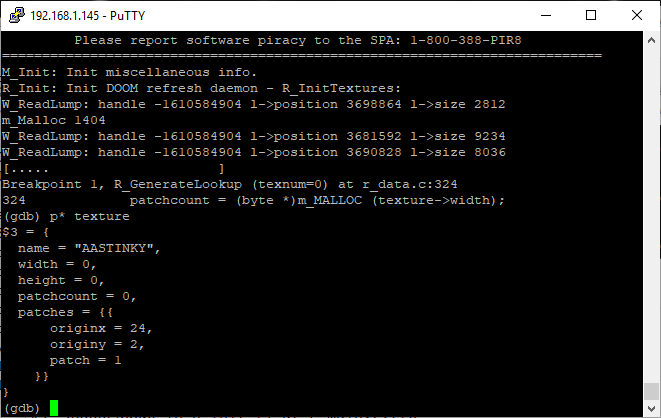
OS X 10.2.8 on the G5 on the same AASTINKY
…It clearly has problems. Although notice that the positions and sizes are the same, as they ought to be.
Notice how originx is 24, which should be the width. This code was running with GCC 1.30/1.40 hammered x68000 GCC. Although I have been unable to get the much vaulted gcc-1.30.atari.tar.bz2 to do anything useful, well until tonight, when I found this file: GNU_HEAD.ARC.
That’s right, it’s the gcc-1.23 release headers for GCC on the Atari ST. Now I know other places people have been saying I should use MINT or some GCC8 port. And I wanted something to run on bare TOS, and I cross compiled the simple Infocom interpreter but it just crashes out after a few commands. It’s hardly stable.
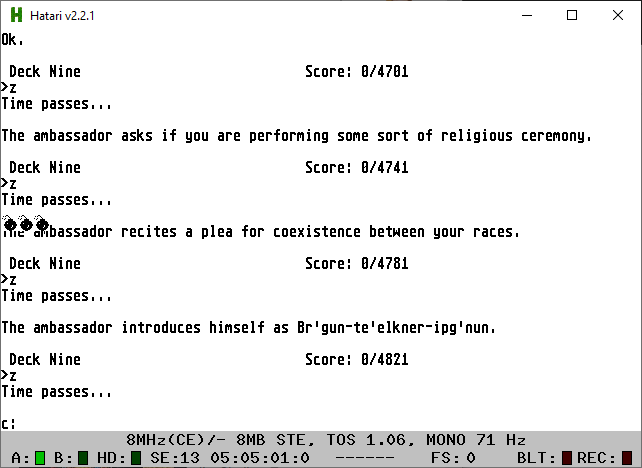
3 bombs and an exit under GCC 8.0
Which is just a damned shame, as it was easier to just download someone else’s work.
Anyways, I now can build the old gcc-1.30 libc however… the linker that I’m using that works for GCC 2 links away and it looks like a working program but it doesn’t do anything. I have a feeling the linker drifted in those years between GCC-1.30 and GCC-2.something when it was adapted. Certainly by the time of 2.5.8. So yet more endian ghosts to chase down if I try to adapt that linker.
This was a lot harder than it should have been. And not because of gcc or surprisingly ancient binutils.
I didn’t have much to go on, as ancient threads like this, or this end up unanswered or without any good conclusion. I guess it’s not surprising that all the attention is to MiNT & MINIX rather than the native platform. But I was not deterred.
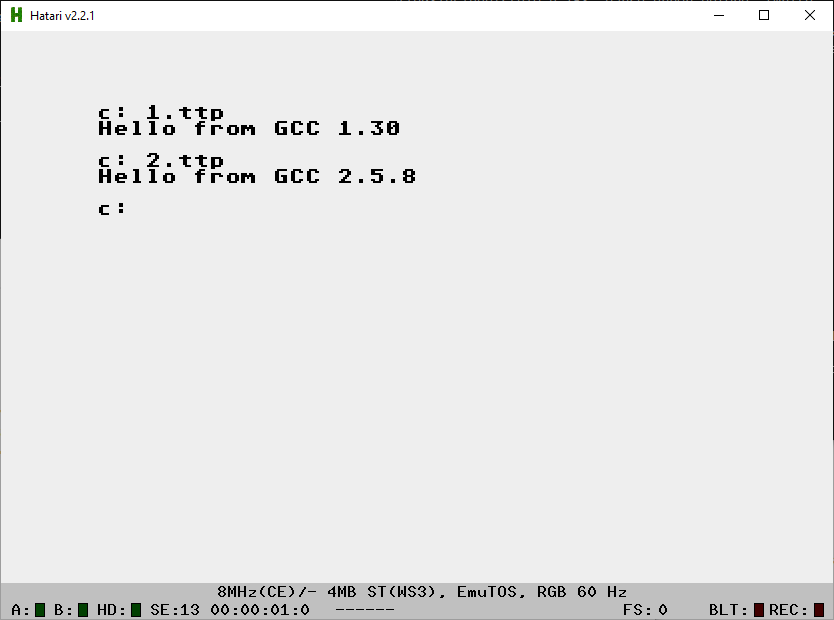
The reason why this was so freaking hard was how so much of key parts of gcc for the ST have been purged and what remains being scattered to the winds. Amazingly the hardest thing to source is the include files. There is a GCC 1.30 file on all the usual GNU mirrors but to save a few kb it has no headers, instead it wants you to reuse the ones from the 1.25 binary distribution. Which is gone. There survives a pl95 binary and source package, but again no includes. Instead I got lucky with all three for pl98. Which has a lot of GCC2 hooks so I cheated on getting the 1.30 hello world by using the 2.5.8 pre-processor.
It’s kind of annoying how all these seemingly tiny files get purged to save a few kb. Just as I can’t for the life of me find the old original GNU libc.
Speaking of files, ZOO has to be the worst compressor ever. Not only is it just overall worse than ZIP, but there are 2 incompatible compression methods, like the introduction of LZD, which any of the good versions of UNZOO can’t deal with. And sure there is zoo210.tar.Z but despite being able to build it on multiple platforms it never does anything useful. All these ancient fileformats sure don’t help anything. And sure there is a MS-DOS version that the MS-DOS Player can run, but get ready for 8.3 filename renaming.
The one good thing that came out of this experience is that since I am building form i386 to 68000 I found that this setup uses the G++ linker which has endian swapping. So maybe I can complete the chain for Mint and MachTen.
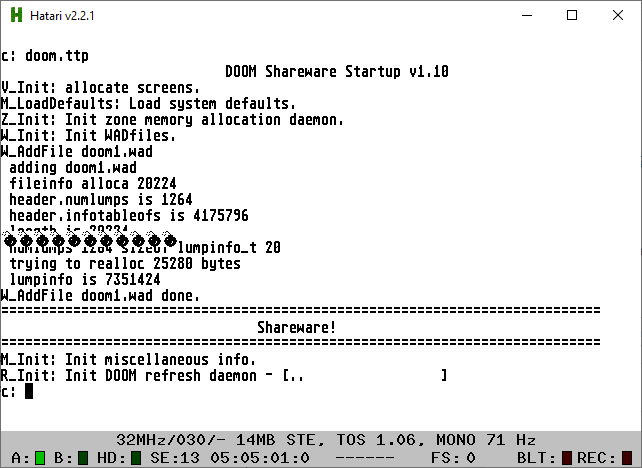
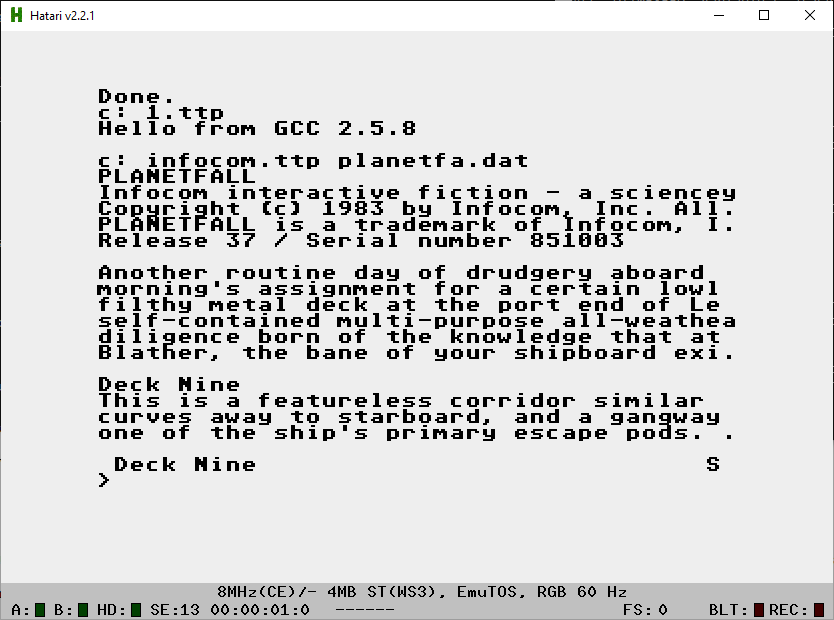
I even got the 1987 Infocom interpreter running. Although I don’t know what the deal is, it seems the larger the GCC based program is the higher chance it’ll just crash on exit or force the next program to crash. Building anything native under emulation was an impossibility.
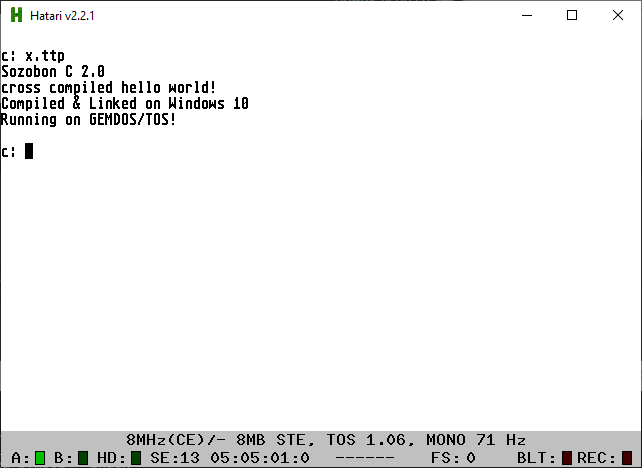
In the same effort, I’ve had the same luck with sozobon. It took way too long to find a working dlibs. I don’t know why people couldn’t either package them together or at least in the same directory. It took far longer just to find the libs… But it was still fun to get that one running as well.
It’s a far more manual process to compile as I have to invoke each stage manually, but at least I’m finally able to get things going.
One of the bigger issues is that I would always find libraries in this olb file format, that the linker from Sozobon wouldn’t recognize. And almost every attempt of trying to build the G++ linker would also fail on. It wasn’t until I was able to get the pl98 include files that I could finally get a linker to actually recognize this … seemingly different for no apparent reason format to actually link. After then I managed to finally find a build of this dlibs that would actually link with Sozobon, which naturally didn’t use olb at all.
So yeah that was an adventure.
I haven’t cleaned it up at all, and really wouldn’t expect anyone else to care, but all my mashed together work (source & binaries!) is here: MinGW-AtariTOS.7z
UPDATE
I started browsing more cd.textfiles.com and amazingly found a ‘home made CD-ROM set’ of Atari software, and buried in the gigabytes of stuff was 4 of the 5 disks of the original GCC-1.23! Namely the source & includes to the first GCC library. I didn’t think this article was going to get any traction, let alone downloads. So many people downloaded the above download.
The default download set is for GCC-1.30, with the headers & lib, along with source. It’s crazy small which just goes for how this old stuff is, and how impact full for losing a few kb.
Also the shell that you use apparently makes a BIG difference. The shell that I was using EmuCON doesn’t show any output from the GCC 1.x libs. However other shells most certainly do. I’ll have to do another update regarding shells/emulation.
I’m using the Linux subystem on Windows, as it’s easier to build this Qemu tree from source. I’m using Debian, but these steps will work on other systems that use Debian as a base.
First thing first, you need to get your system with the needed pre-requisites to compile:
Now for me, GCC 7 didn’t build the source cleanly. I had to make a change to the file config-host.mak and remove all references to -Werror. Also I removed the sound hooks, as we won’t need them. remove the following lines:
CONFIG_AUDIO_DRIVERS=oss
CONFIG_AUDIO_OSS=m
Now you can build Qemu. it’ll happily build in parallel so feel free to build using the -j parameter with how many cores you have. I have 32, so I use
make -j32
Okay, all being well you now have a Qemu. Now following the steps from Artyom Tarasenko’s blog post, we can get started on the install!
First we create a 8GB disk
qemu-img create -f qcow2 aix-hdd.qcow2 8G
Next we need the custom BIOS with serial as the console.
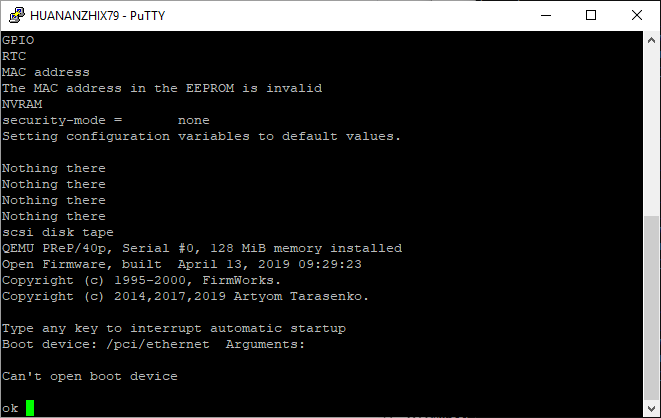
Now telnet to your localhost on port 4441 and you will see the console doing it’s BIOS initialize and eventually drop to the OK prompt.
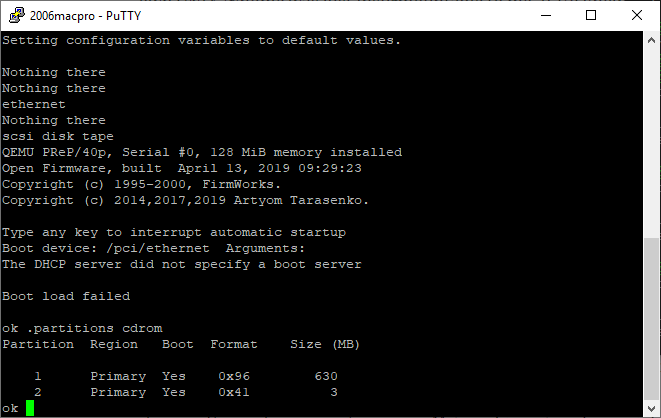
One trick I’ve found is that from the Open Firmware prompt you can find out what partitions are recognized from the firmware. If it see’s partitions then there is some hope that the image you have is valid enough to boot. In the last few days I’ve found quite a few AIX images, which are lacking the partition table, and unable to boot.
.partitions cdrom
simply type in boot cdrom:2 to kick off the installer. It may take a minute or so for the installer to kick off.
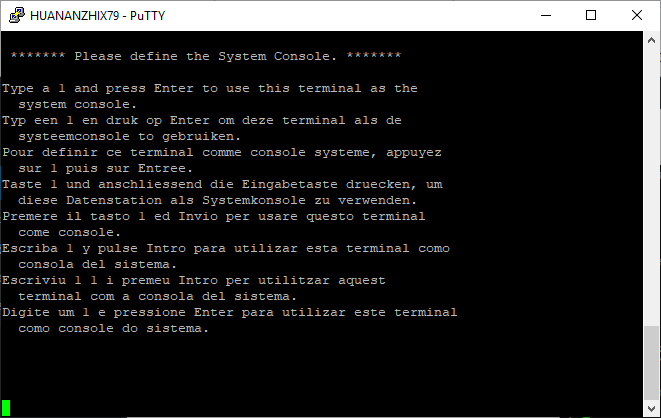
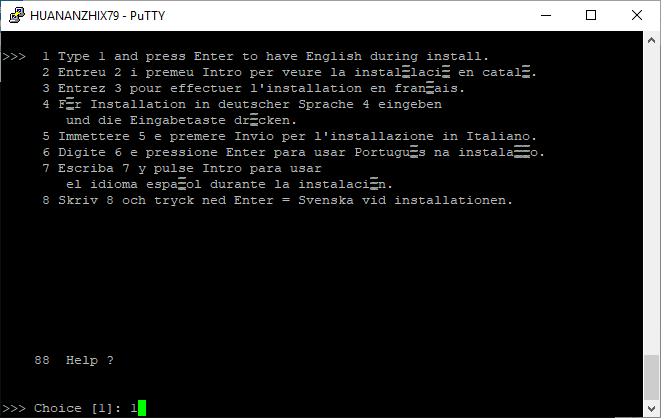
If all goes well, you’ll see the BIOS reload itself, then after a minute you’ll be prompted to press 1 to select the console
It doesn’t echo, don’t panic!
Next select your language. I’m doing English.
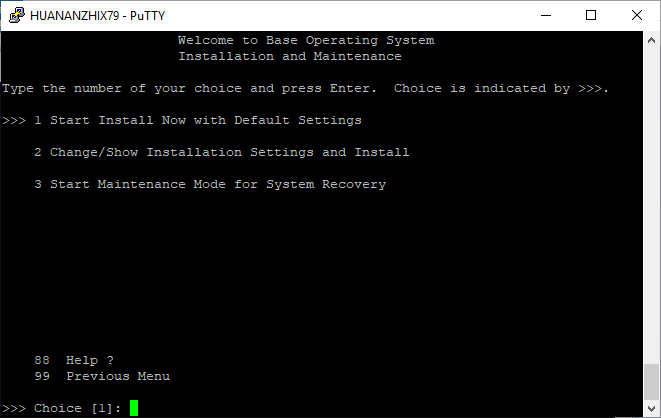
Next it’ll ask about installation type. Default ought to be fine.
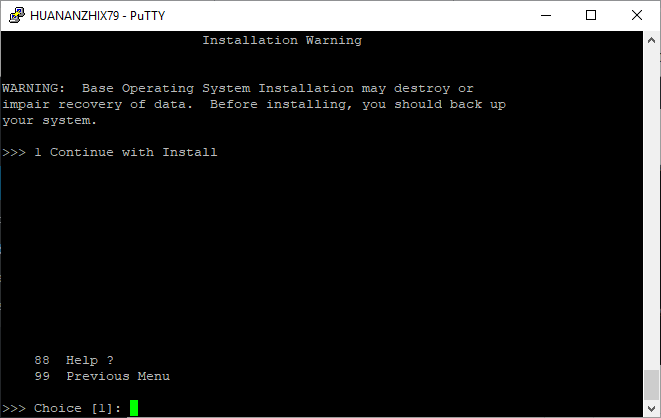
Because this will destroy the contents of the disk (which doesn’t matter as it’s blank) it’ll prompt for confirmation.
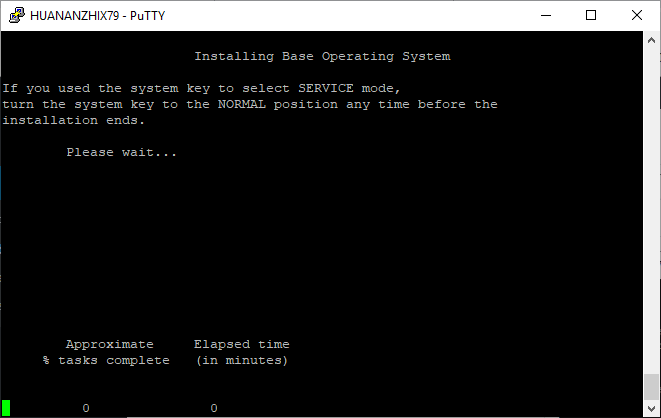
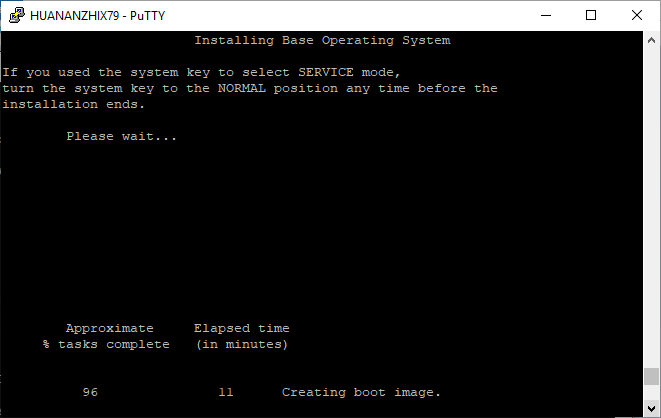
After this it’ll begin the installation. Depending on how fast your disk & CPU is this will take a while.
For me, the installation took about 11 minutes. This is using my Xeon E5-2667 v2. It took 17 minutes on my 2006 Mac Pro, with X5365’s it .
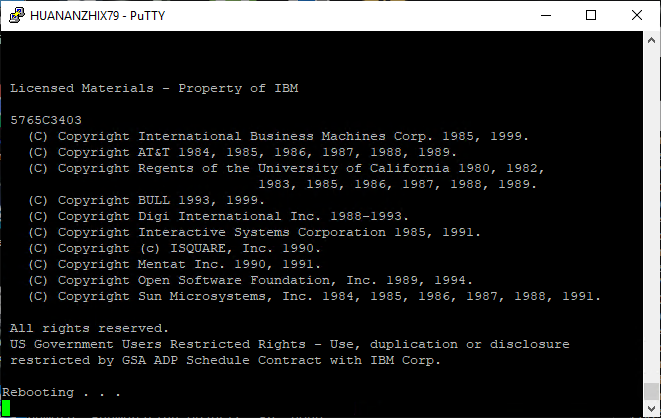
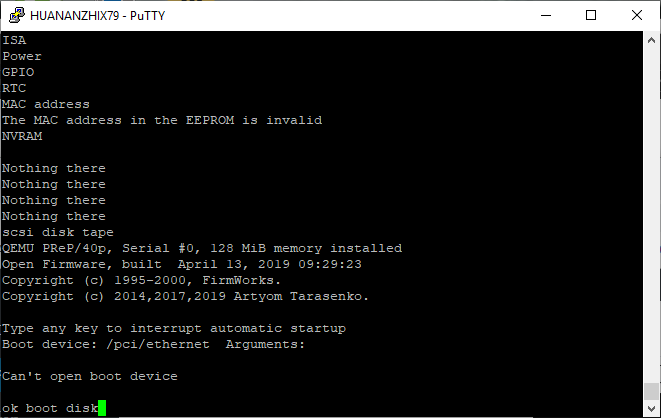
After it’s done, right around the 96% time it’ll reboot back to the BIOS
Once you are back at the OK prompt, you can now boot disk:
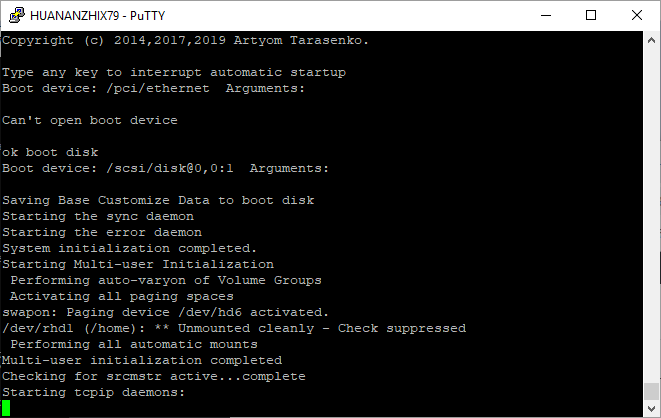
it’ll look like it’s hung for a minute, then it’ll start booting from disk!
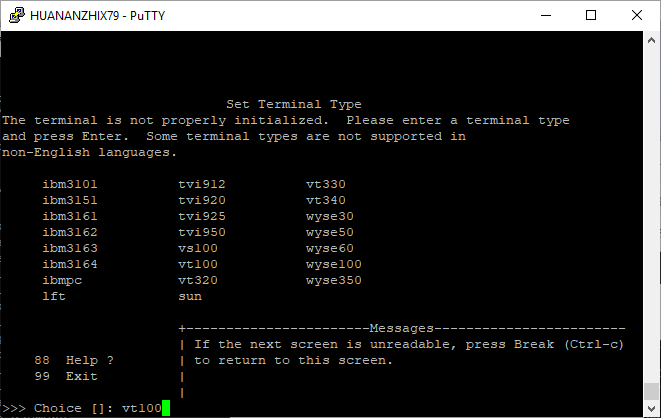
Once the OS is booted up, you select the terminal type. I’m using putty but I’ll select the vt100. Of note the function keys are selected by hitting escape and then the number key. So F3 is ESC 3.
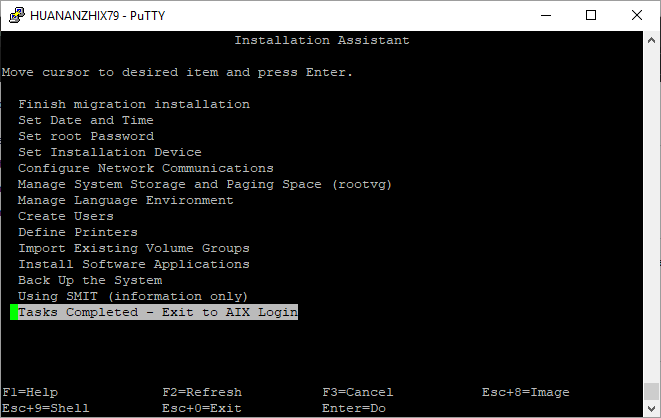
I’m just going to finish the install, as we can always run smitty to mess with the system more, but right now I’m just interested in a base install of the BOS (Base Operating System, and IBM ISM).
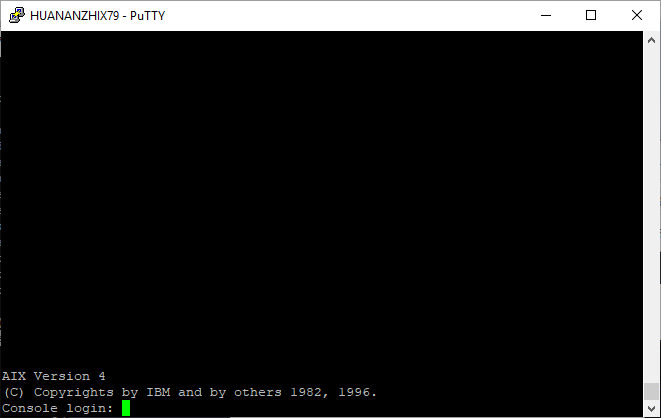
A few moments later, you’ll get dumped to the login prompt.
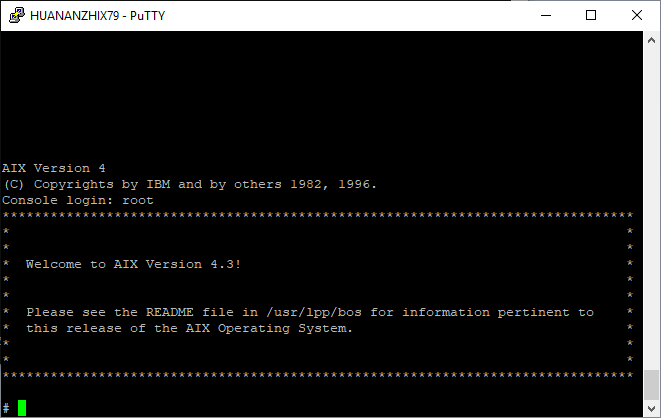
By default there is no password, so just login as root, and there you go, your very own virtual AIX 4.3 system.
# uname -a
AIX localhost 3 4 000000004C00
So there you go! All thanks to Artyom’s hard work!
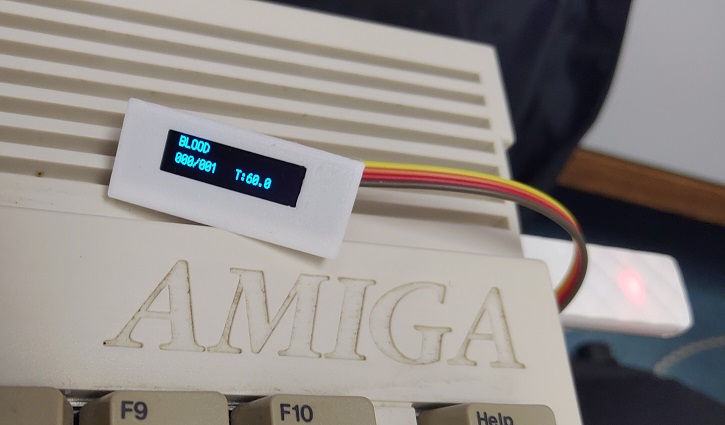
It was everything I had hoped it to be. I paid extra for a 3d printed mounting bracket and the cute led display.
I had one adf handy to test, Captain Blood, a nice pirated version so the weird encoding wouldn’t be an issue.
It was kind of nice watching it boot up, although as slow as I remember a mechanical drive being. But at the same time nice not using 30 year old media.
I have a few more upgrades on the way to deck out my 600, although I need to do some kind of RGB thing as the composite video has so much noise it’s unreal.
Anyway despite the old flame war on floppy emulation, the Goteks are dirt cheap, and. Hell if it’ll work in an Amiga, it’ll work anywhere.
So I woke up to this incredible news. Jason Scott at the most excellent archive.org had just uploaded the old Infocom source code to github. It’s from the infamous ‘found hard disk’ that has been mentioned going back to the failed game ‘The restaurant at the end of the universe’.
So looking at the repos here, you can see the latest ones are all Infocom. It’s best to get them all via git for reason below:
The reason being of course that if there are multiple versions they are stacked. Now why is this important? Who cares? it’s all in ZILL which there is no compiler for, as the TOPS-20 tools are still lost?
Written by Jesse McGrew in an apparent vacuum, this toolchain can Z3 machine based ZIL source code. Yes that’s right it’s a compiler!
I know Zork will get all the headlines, but back the 80’s I preferred Planetfall. I’m not even going to talk about the insanity that was the Hitchhiker’s guide to the galaxy.
Zilf is really only suited for Z3 compilation, and looking at planetfall there are two commits of note:
The source for the Final version won’t build with ZILF. However the Revision 37 source will!
$ git checkout 281bd3417faada8011397244d4bfaad562cb7bfc
Note: checking out '281bd3417faada8011397244d4bfaad562cb7bfc'.
You are in 'detached HEAD' state. You can look around, make experimental
changes and commit them, and you can discard any commits you make in this
state without impacting any branches by performing another checkout.
If you want to create a new branch to retain commits you create, you may
do so (now or later) by using -b with the checkout command again. Example:
git checkout -b
HEAD is now at 281bd34... Revision 37 (Original Source)
Ok, now let’s trash the directory! (you did backup the repo first, right?)
C:\temp\zilf\zilf-0.8\planetfall>..\bin\Zilf planetfall.zil
ZILF 0.8 built 3/19/2017 1:34:17 PM
Planetfall
[warning MDL0417] C:\temp\zilf\zilf-0.8\planetfall\MISC.zil:509: ROUTINE: only 3 routine arguments allowed in V3, so last 2 "OPT" arguments will never be passed
in INSERT-FILE called at planetfall.zil:14
in IFILE called at planetfall.zil:25
[warning ZIL0208] C:\temp\zilf\zilf-0.8\planetfall\SYNTAX.zil:143: preaction routine mismatch for 'V?ZAP': using PRE-ZAP as before
[error ZIL0113] C:\temp\zilf\zilf-0.8\planetfall\MISC.zil:150: SETG: argument 1: bare atom argument must be a variable name
[error ZIL0113] C:\temp\zilf\zilf-0.8\planetfall\MISC.zil:315: SETG: argument 1: bare atom argument must be a variable name
[error ZIL0113] C:\temp\zilf\zilf-0.8\planetfall\MISC.zil:317: SETG: argument 1: bare atom argument must be a variable name
[error ZIL0113] C:\temp\zilf\zilf-0.8\planetfall\MISC.zil:319: SETG: argument 1: bare atom argument must be a variable name
[warning ZIL0504] C:\temp\zilf\zilf-0.8\planetfall\PARSER.zil:244: treating SET to 0 as true here
[warning ZIL0502] C:\temp\zilf\zilf-0.8\planetfall\VERBS.zil:156: RETURN value ignored: block is in void context
[warning ZIL0204] C:\temp\zilf\zilf-0.8\planetfall\VERBS.zil:1879: no such global variable 'WHERE', using the local instead
[warning ZIL0505] C:\temp\zilf\zilf-0.8\planetfall\COMPTWO.zil:3035: COND: clauses after else part will never be evaluated
[warning ZIL0308] : too many parts of speech for 'PORT': Object (C:\temp\zilf\zilf-0.8\planetfall\GLOBALS.zil:78), Adjective (C:\temp\zilf\zilf-0.8\planetfall\GLOBALS.zil:224), Direction (C:\temp\zilf\zilf-0.8\planetfall\GLOBALS.zil:11)
[warning ZIL0306] C:\temp\zilf\zilf-0.8\planetfall\GLOBALS.zil:224: discarding the Adjective part of speech for 'PORT'
[warning ZIL0308] : too many parts of speech for 'BRUSH': Object (C:\temp\zilf\zilf-0.8\planetfall\GLOBALS.zil:548), Adjective (C:\temp\zilf\zilf-0.8\planetfall\GLOBALS.zil:549), Verb (C:\temp\zilf\zilf-0.8\planetfall\SYNTAX.zil:283)
[warning ZIL0306] C:\temp\zilf\zilf-0.8\planetfall\GLOBALS.zil:549: discarding the Adjective part of speech for 'BRUSH'
10 warnings
4 errors
C:\temp\zilf\zilf-0.8\planetfall>dir *zap
Volume in drive C is BOOTCAMP
Volume Serial Number is 903B-72D4
Directory of C:\temp\zilf\zilf-0.8\planetfall
04/17/2019 08:32 PM 247,803 planetfall.zap
04/17/2019 08:32 PM 162,476 planetfall_data.zap
04/17/2019 08:32 PM 1,336 planetfall_freq.zap
04/17/2019 08:32 PM 40,495 planetfall_str.zap
4 File(s) 452,110 bytes
0 Dir(s) 238,542,704,640 bytes free
C:\temp\zilf\zilf-0.8\planetfall>..\bin\zapf planetfall.zap
ZAPF 0.8
Reading planetfall.zap
Reading planetfall_freq.zap
Reading planetfall_data.zap
Reading planetfall_str.zap
Measuring..
Assembling
Wrote 121952 bytes to planetfall.z3
Sure it said 4 errors, but it compiled! Using a z3 or higher interpreter we can load up Planetfall
Planetfall!
At first glance it may look the same, but check the serial number. 190417. That’s today!