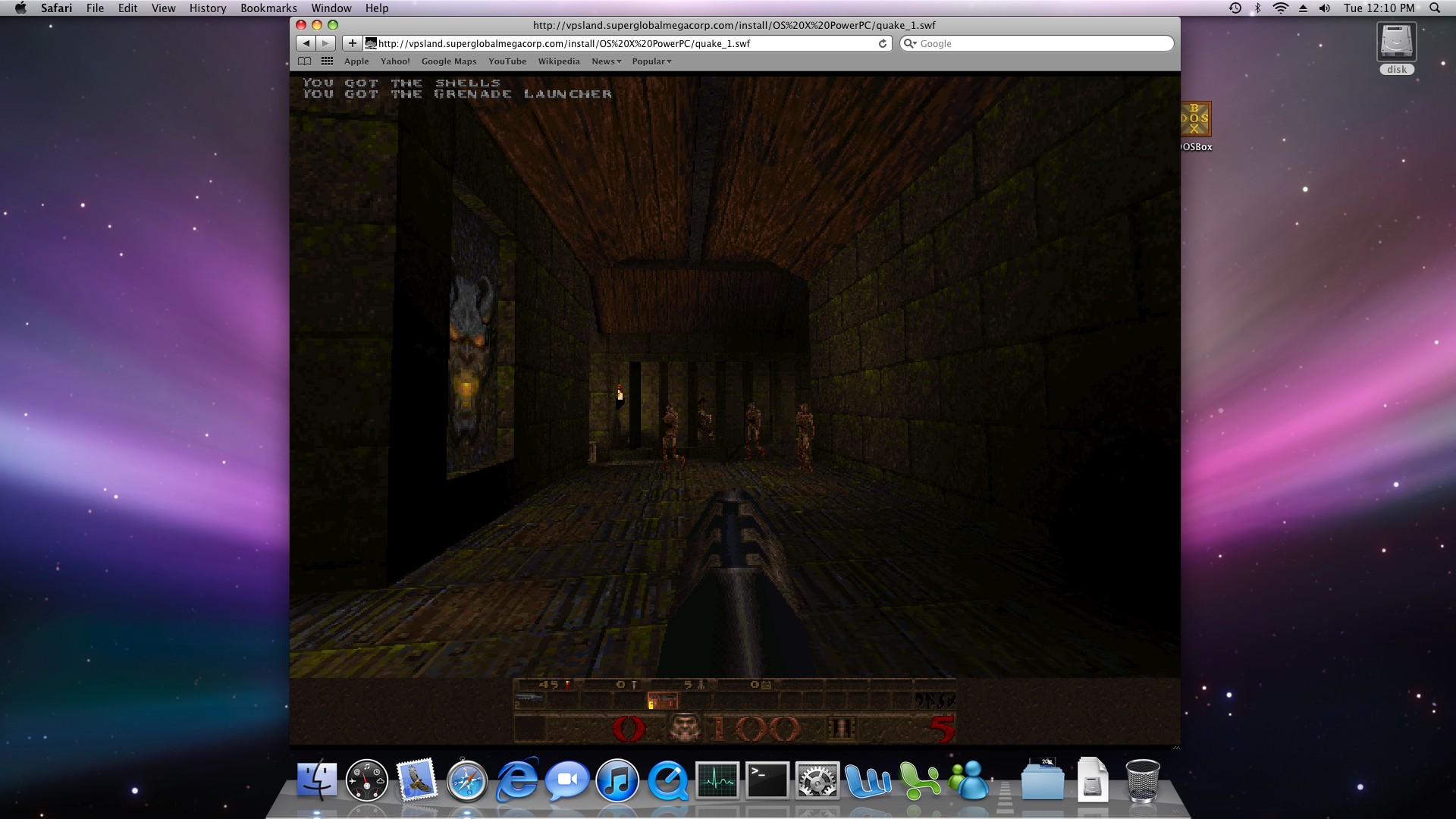
I’ve been meaning to write something about the whole Microsoft foray into the Java language, and where we are today as a result. I know in 2012 it is hard to imagine a world where Java wasn’t just ignored or marginalized (don’t even pretend that Oracle buying out SUN didn’t drive people away) but rather there was a lot of excitement built around Java, and all the language companies were getting behind Java. Yes this included Borland, and of course Microsoft. And not to be left out of making a compiler, but Microsoft also wrote their own JVM, or Java virtual machine runtime. Even more un Microsoft like, is that they provided Internet Explorer and their java on the Macintosh!
“Microsoft is offering a real Mac program at an incredibly attractive price: free. Plus, it comes with a few nifty tools you won’t find at http://www.netscape.com/: A good Java virtual machine and just-in-time compiler, which allows you to run Java applets anywhere, not just in your browser, and even a small but robust Web server.”MacWEEK “Microsoft may have won the browser war”
Joanna Pearlstein February 28, 1997
In this brief period of cross platforming products, Microsoft also had Internet explorer for the SUN, and HP workstations (Solaris/HPUX).Even back in 1997 – 1998 Microsoft was going strong on Java, to the point they were re-writing their website to use as much java/javascript as possible, they had even created DHTML the underpinnings for what we call AJAX today. Microsoft however didn’t capitalize a new server platform and branding for their J++, but rather relied on NT 4.0 and IIS. Not that this was ‘bad’ or unexpected, but notice that they considered this a lesson learned in marketing and pushed for a .net server although the car people had their win to rename it to 2003.The other thing of course, was that from the 1.0 to 1.1 specification of Java, Microsoft didn’t wait for SUN to fix the language, they instead took it upon themselves to do so, and of course added in lots of Windows only functionality. This of course led to the protracted lawsuit that won Sun a nice chunk of cash, and pushed Microsoft out of the Java business. Not to have had all that effort wasted, Microsoft then took the JVM and retooled it into the .net platform that we all know and love today. And while SUN was busy trying to make Java the new business COBOL, Microsoft has been making the .net platform business cobol, by letting people choose what language they wish to use, even… COBOL (from Fujitsu IIRC).Installing J++
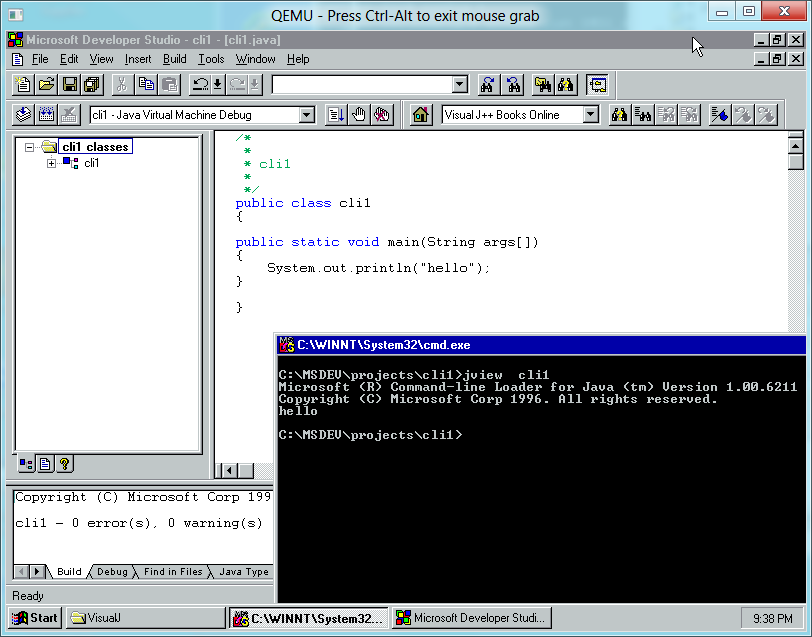
So on the weekend I came across this book on “Web programming” which I’d usually laugh at for being obsolete and ignore, but it proudly mentions that the included CD includes the ‘publishers’ version of J++ 1.0!  So I checked the book, and yes the CD is still there! So for the 2-3 people that care, I even packaged this fifteen year old oddity. It’s demanding requirements are NT 4.0, or Windows 95 with sixteen (Yes sixteen!) megabytes of ram, and 100MB of free disk space. Personally I just installed it in a blank NT 4.0 unpatched VM. It’ll install IE 3 along with it, and version 1.00.6211 of the Microsoft JVM.
Naturally even emulated, on a 3Ghz CPU with a gigabytes worth of RAM it runs and compiles quite quickly.
Hello!
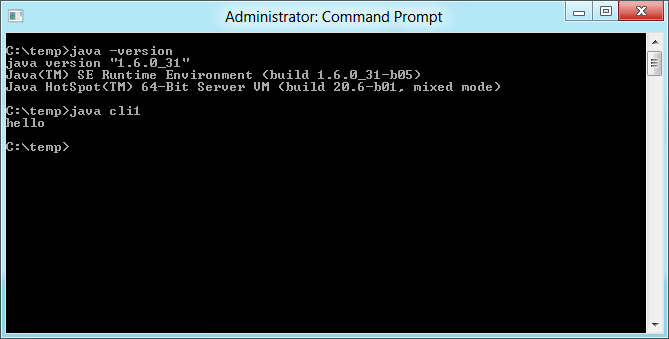
I know it isn’t much  to look at, and the download is small it is quite neat for the age/size… But yes, even ‘modern’ java can run “well behaved” J++ apps..
Running my J++ 1.0 hello program
As part of the trial though Microsoft had to pull everything with the JVM in it, and that included IE 3.0 “full”, 4.0 and 5.0/5.5 .. Even Windows 2000 sp3, and prior had to go. Yes this is also why Office 97 & SQL 7 are gone from the MSDN downloads. Maybe its my nostalgia but I really did like the 1997-1998 era and their applications. The only reason I “upgraded” out of Outlook 98 was that 2003 can connect to Exchange 2003/2007 servers with a built in HTTP connection so I don’t have to VPN to send/receive email.
I nearly forgot about this ancient page with some applettes. Amazingly they still run.. Since my experience with Java has been largely write once, debug everywhere…
So I was looking for an old favorite of mine, Internet Explorer for OS X, and I found this site, internetexplorermac.org
While it doesn’t have a lot of information about this old abandoned and PowerPC only release, it does maintain a download for this old browser.
For all of you, running Intel OS X, without rosetta you can’t run this. Although if you still have Tiger, or Leopard, then yes you can run IE 5.2.3 for OS X.
Well I’d say it was a few simple reasons. First the internet in 1983 was a very limited ARPANET, which was a big deal for an institution to get onto, let along an individual.
In the quick Slashdot post, they go on about the Viewtron service offered by AT&T. And why did it not become such a major success, where the internet trumped everything?
Its quite simple, nobody likes a walled garden. You can bet that AT&T wouldn’t allow people to just spout off their opinion wherever on their network. Even today there is a limit on what you can say on corporate networks, and on corporate systems. The big thing about the internet is that anyone can not only register a domain, but easily get access to server software and become their own ‘site’ on the internet independent of what large corporations may think, or wish.
The other thing to remember is the state of personal computing in 1983. While the rise of personal eight bit computing, there was no ‘open’ networking standards on which to build large scale networks. Because everything had to be licensed, and people were expected to pay big money for those technologies, people (hackers!) ended up writing them on their own. Even the mighty internet today is more so because of hackers, and not from major corporations. And fill the gap they did with what limited systems were available with BBSes and FIDONET.
What about UNIX?
While UNIX was a popular OS and the hackers dream, in 1983, getting a PC to run UNIX was a BIG endeavor, as the hardware was super expensive, and licensing was very restrictive. The big ‘player’ of course was Microsoft via SCO with Xenix. For example in 1983, an Apple Lisa was $9,999. And Xenix could easily set you back some $2000 for the OS alone.
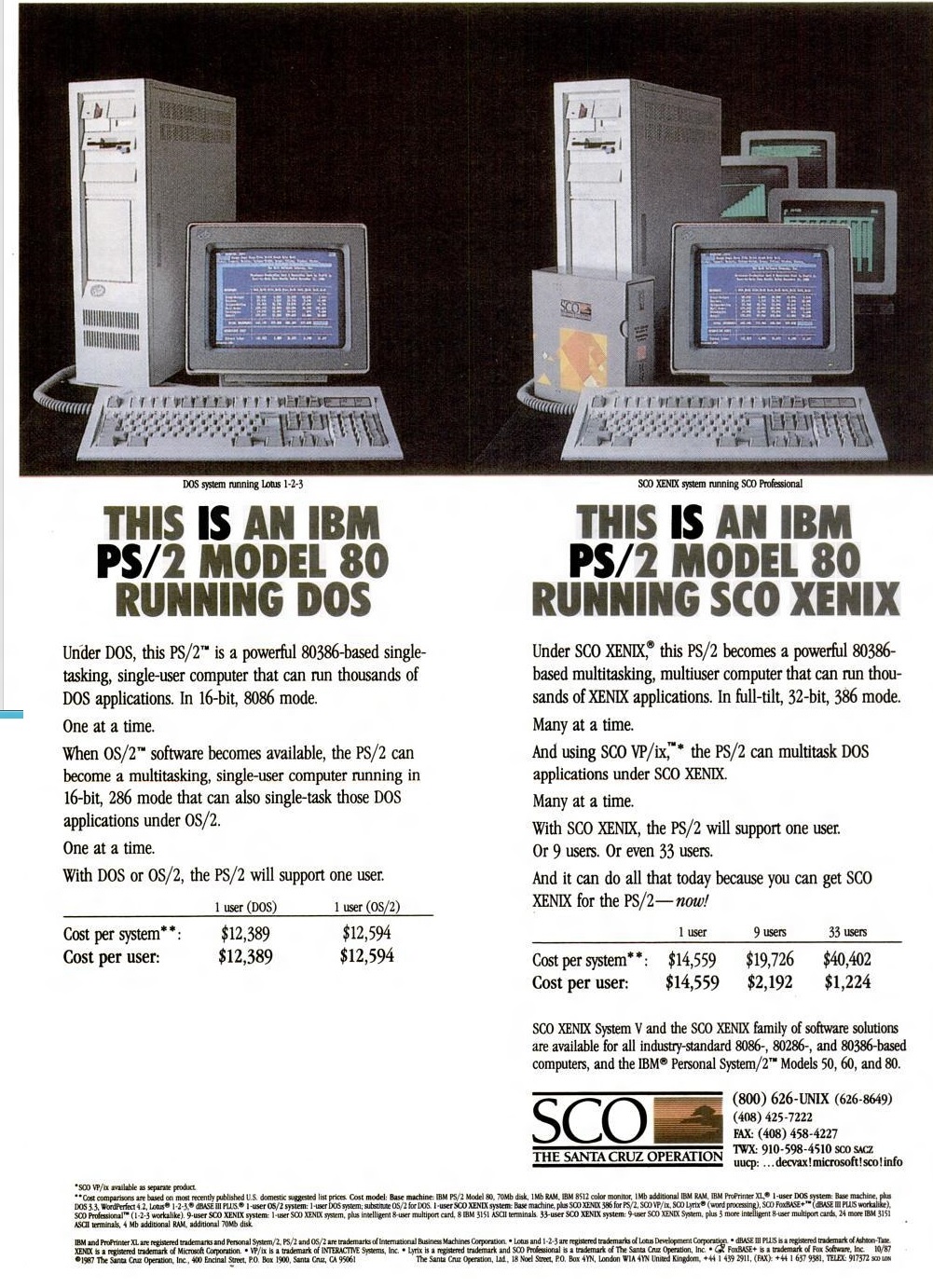
Even by 1987 a decent Xenix machine could still set you back some $15,000! That would be $27,567.45 in 2010 dollars! And that is just a ‘runtime’ machine, no STREAMS, TCP/IP, and NO COMPILER!
$14,559 for UNIX in 1987!
This of course raises me to the next point about the lack of affordable 32bit general computing in 1983, and software. Even at the university level the kind of machine that was going to be connected to the internet was a massive ‘mid’ range machine like the VAX 11/780 running BSD Unix. Even back then BBN was trying to get its proprietary TCP/IP stack into a ‘base’ UNIX, which would further encumber the distribution of UNIX, while Bill Joy freed us all by providing BSD 4.2, and licensing it for free with only four clauses to be redistributed, and altered at will. Which was fantastic, but the hardware requirements vs what anyone could buy off the shelf was.. a massive gulf. While a VAX with 8 MB of ram, a 500MB disk, and an Ethernet adapter (which was again an open standard) would cost several hundred thousand dollars, the 68000 chip from Motorola was changing everything, and was democratizing network stations first with Apollo, then with SUN.
Heck even SUN was founded on trying to bring BSD 4.2 to the masses, and the SUN-1 didn’t even run BSD UNIX but rather a UniSoft port of UNIX v7. Even from the business plan, the expected price at retail was $7000.
Of course as good as the hardware was getting “affordable” where a workstation would cost as much as a mid level car, the software however was *NOT* free. This is where Richard Stallman stepped in with the FSF, and started to replace piece by piece all the software on SunOS with free & open equivalents. It wasn’t until 1991 that there was enough GNU/Free software from that end to even start to bootstrap a free system (Linux). Even the BSD people with their NET/2 release wasn’t ready until 1991 as well.
In addition take a look at this computer from 1991:
It is comparable to the $14,500 IBM PS/2 model 80, but at $2,295 it is something that the average user could afford. And even in 1991 there was the beginnings of free & Open UNIX via Linux & 386 BSD to run.
So as you can see with the rise of affordable 32bit computing, open software with open networking standards in software and hardware that made an open network prevalent.
As we move into the future the larger question to me is, are people going to accept the big networks trying to turn the clock backwards to these ‘gardens’ where you must obey your corporate owners, never speak ill of them, and live with all the censorship.. I still believe that what made the internet unique is that not only could you participate in a global network, but you could with little investment become part of it. Just as someone like me who had an issue with blogger being down for a protracted amount of time, was able to take my content and host it myself. Something you cannot do in the walled garden of networks.
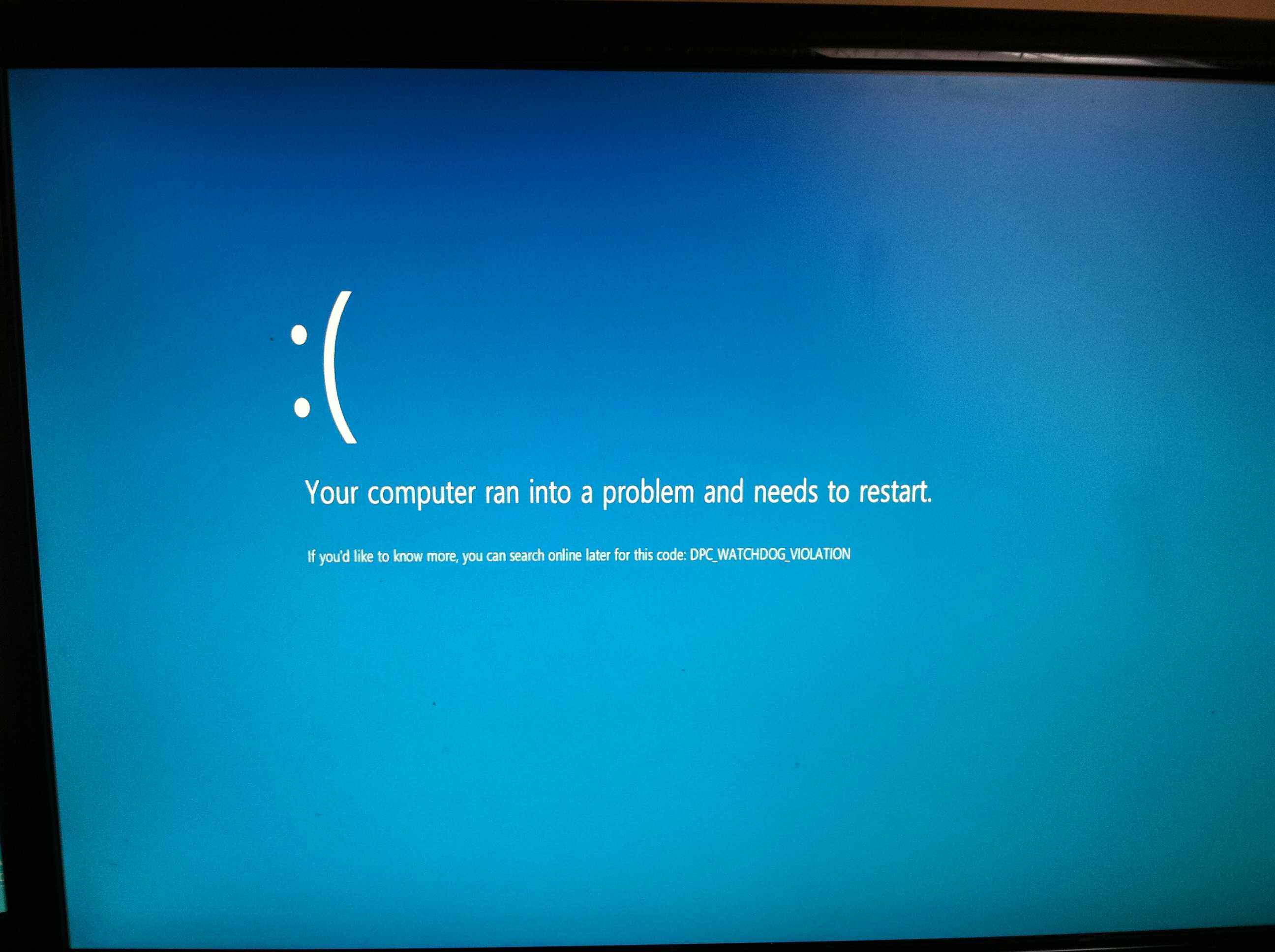
I don’t know what has been going on but my PC has been acting weird. Â Windows 7 didn’t do squat to even help to identify what on earth was going on, but now I guess the hint is DPC_WATCHDOG_VIOLATION
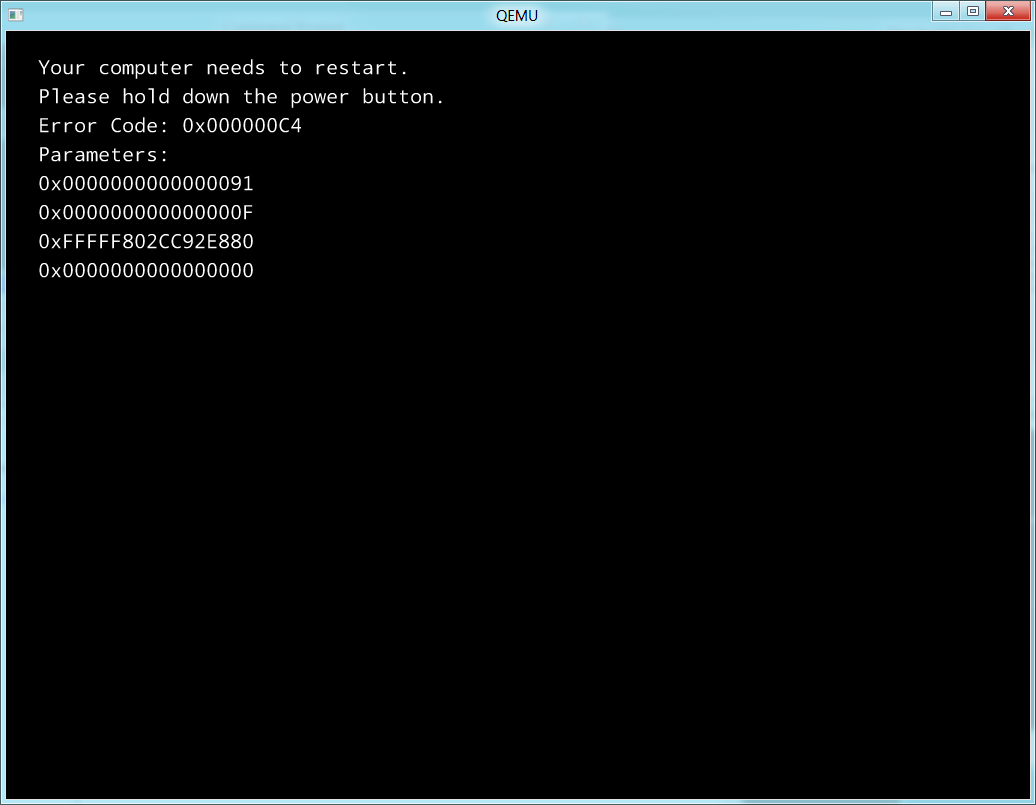
Since people have been asking, does it work with Qemu 1.0.1? Â And the answer, sadly is ….
sadly…
no.
As you can see the primary error code is 0x000000c4
0x0000000000000091
0x000000000000000f
0xfffff802cc92e880
0x0000000000000000
And that is about it….. Â And of course keeping in mind that Qemu hasn’t been able to boot a 64bit version of Windows since 0.9.0 and Windows XP x64/Windows 2003.