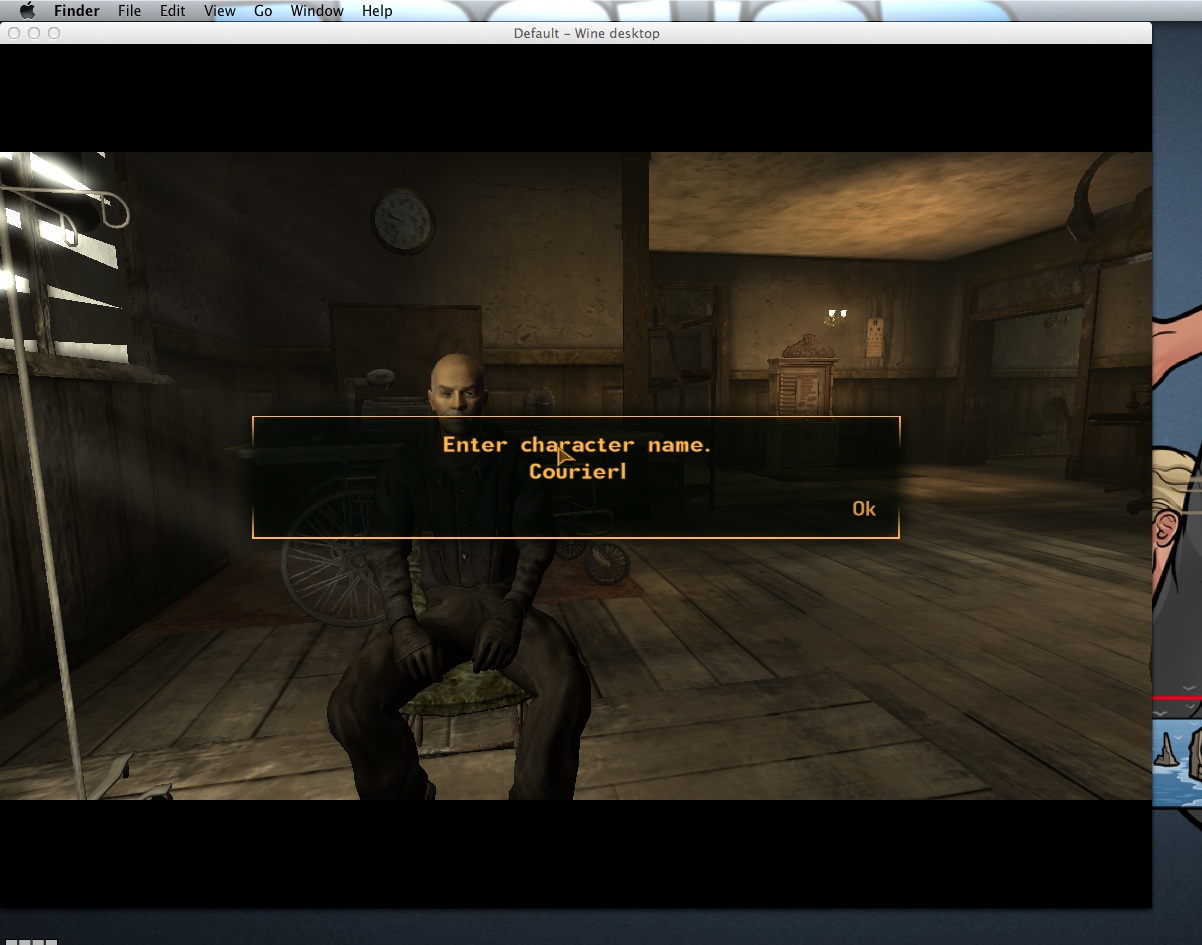
So I’ve been dying to play this on OS X for quite some time to no avail.  So after the CrossOver give away I thought I’d be set! .. I installed steam, spent forever downloading and installing Fallout to only get either a blank white screen when running in full screen mode, or a black window running in a window.
So finally messing with ‘bottle’ settings I stumbled on the ability to run a session in an ’emulated desktop’. Â And with that setup with a big enough resolution, boom run it again and it works fine in a window!
Sadly I never held onto my save games so looks like I’ll be starting from scratch.
Not to shill too hard for it, but it is for sale for 10 euros, or 8 pounds sterling.. Â I should hope that this 1997 classic should work on modern PCs.. Which has been a pain for anyone whos owned this when it originally came out for the PC. Â Although as far as I can tell this doesn’t add anything from the original version … Other than some click to cheat thing but.. There you go.
Well for some reason I was interested in Tetris (ТетриÑ), and wanted to find an early version. Looking around I did manage to find some background by Vadim Gerasimov, on the whole origin of Tetris. What I never realized is that the first version was written for a Soviet PDP-11 clone, then ported to the IBM PC using Turbo Pascal! Or that it was all done in text mode! The thought at the time is that every PC could run 40 column mode and thus would run Tetris.
Along the way I did manage to find some other early Russian artifacts for the IBM PC, namely MS-DOS 4.01 which not only has its own site but has an excellent view into the history of localizing MS-DOS, and what the culture was like at the time. There is even a promo video in Russian of course.
And I did come across a ‘Перевод’ of Windows 2.1 done in 1990, but no luck on Windows 3.0 .. I wonder if they ever had OS/2 1.x ..? Which speaking of non english versions of OS/2 1.x seem nonexistent, but I did find reference to there being a release in Japan, but naturally not even a screen shot.. I did find one rather harsh review of Windows/286 2.1 (PуÑÑкий), but seeing as far as I can tell there was no Excel 2 or Word 1 for Windows in Russian it would have been pointless running it back then. Unless you had the 386 version!
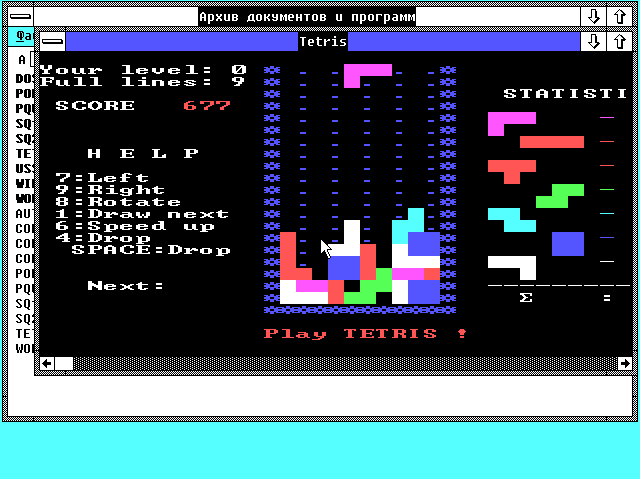
So, I figured, I’d mash in as much of the Russian bits into Windows/386, add in Tetris, and include some Amiga MOD files for the music (yes, besides being text based, there was *NO* music in the original Tetris! The Adlib! didn’t exist back then). I’ve used the excellent 8bitboy to play the music. You can mute if you so wish, or skip around to various tracks…
Tetris on Windows/386
So while not all that ‘authentic’ it’s close enough I think…
That’s right, it looks like SoftShadowsATI causes the thing to bomb out. Â So disabling shadows has lead to a much better experience so far. Whats also odd, is the driver says its for a 9700, while the hardware is a 9600 … But I don’t know enough about ATI stuff to say anything about that…
I never did get around to KOTOR on my quad G5 with the Nvidia card…
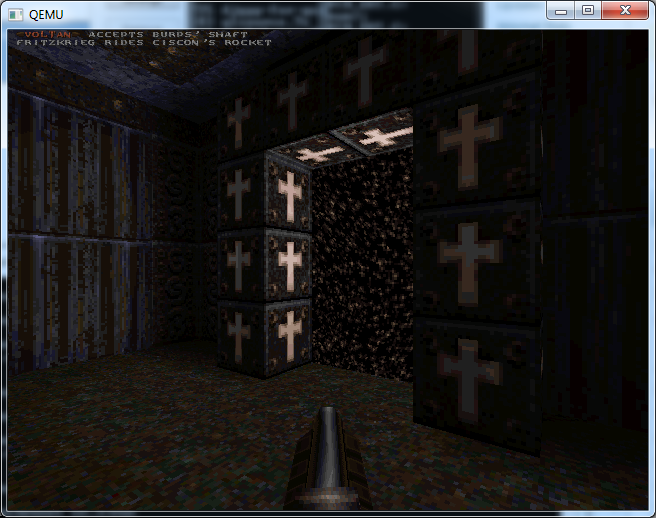
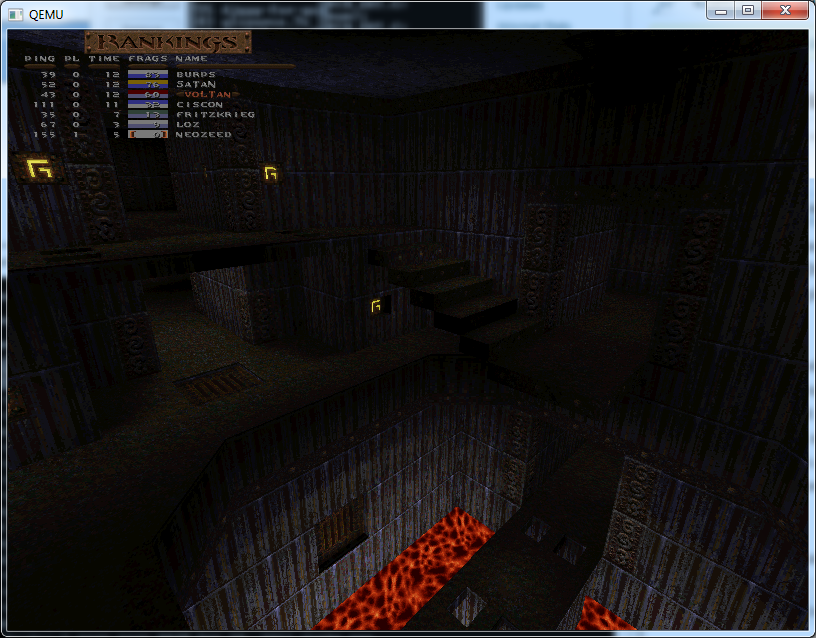
So after a year+ of inactivity I’ve spent some time with Quake (netquake) and QuakeWorld for MS-DOS. Â I had modified it to support the WatTCP stack for MS-DOS, allowing you to play over the internet with any MS-DOS PC with a packet driver.
After a good bit of prodding and playing with DJGPP I’ve updated everything to include some new tweaks for a malloc ‘bug’ (Quake assumes the memory is clean, which under DJGPP it isn’t) some limit increases (zone to 1MB, and increases in max edicts, models & sounds), and forcing the sound to 22050Hz.  The source code is now here.  As much as it pained me, I built it with this DJGPP under MS-DOS (On Qemu) and I’m keeping it here, as gcc 3 & 4 are incapable of building a working WatTCP or Quake.
Another big fix for QuakeWorld is that it now can run in 640×480, 800×600, and even 1024×768 if your video card is VESA 2.0Â compatible!!!
Basically you can just replace the default exe’s in a Quake1 install and go from there. Â If you do not have quake at all, you can always look for the shareware version. Â QuakeWorld will require the commercial version for what it is worth. I’ve found it runs best with 32MB of ram. Â I don’t know if that is even an issue in this day & age. Â Quake1 will run in 16, but I have a feeling QuakeWorld runs in VM (thanks to CWSDPMI) and it does say it is using 32MB … Because I clear the ‘zone’ before Quake runs there may be a 30 second to 1 minute pause. Â This is to be expected, just hold tight.
Not sure why its suddenly working…. but I suspect it may be either updates to both OS/2 base OS & TCP/IP or…. it is because I’m using the QuakeWorld server code that matches the client…. Anyways I’ll upload a binary and the rest later as it is super late. Â But for those of you who want to see it…
Yes it really is an OS/2 exe built with EMX!
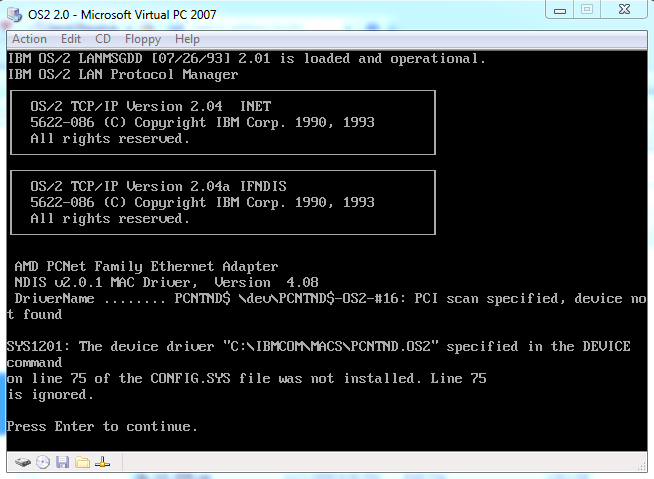
I’ve updated the sourceforge page to include an exe, and a copy of the updates that I’m using to OS/2.. Oddly enough my OS/2 install with Virtual PC no longer works… The NIC isn’t found anymore, must be some update? Â I’ve got 6.0.192.0, although I know for a fact that this image used to work…
Broken driver
Further update, turns out I’m retarded the AMD PCNet driver is for VMWare/Qemu … Virtual PC emulates a DEC 21140a, which I downloaded a NDIS2 driver from Intel which works great. Â I do have to turn off hardware assisted virtualization otherwise OS/2 won’t boot at all from the hard disk.. Â I’m not sure if it is because I’m now on an AMD computer, or if it is the matched QuakeWorld server/client but it works fine… in Qemu & Virtual PC.
It’s been a long while since I’ve posted anything VAX BSD related.  So I found this ISO image a while back that had all these old versions of BSD on them, but sadly many of them are incomplete, missing parts, and give really no clue on how to use them.  There is even some duplication thrown in there just to complicate things further.  So I figured I’d try one of them, an interim release of 4 BSD and see if I could just overlay a newer release version and see what I get…
VAX780 simulator V3.8-1
Listening on port 23 (socket 156)
loading ra(0,0)boot
Boot
: ra(0,0)vmunix
215688+63964+69764 start 0xf98
4.1c BSD UNIX #2: Tue Aug 28 09:39:12 PDT 1984
real mem  = 8384512
avail mem = 7036928
using 148 buffers containing 838656 bytes of memory
mcr0 at tr1
mcr1 at tr2
uba0 at tr3
hk0 at uba0 csr 177440 vec 210, ipl 15
rk0 at hk0 slave 0
rk1 at hk0 slave 1
uda0 at uba0 csr 172150 vec 774, ipl 15
ra0 at uda0 slave 0
ra1 at uda0 slave 1
zs0 at uba0 csr 172520 vec 224, ipl 15
ts0 at zs0 slave 0
dz0 at uba0 csr 160100 vec 300, ipl 15
mba0 at tr8
root on ra0
WARNING: should run interleaved swap with >= 2Mb
Automatic reboot in progress...
Tue Aug 28 09:54:53 PDT 1984
/dev/rra0a: 836 files, 6010 used, 1419 free (35 frags, 173 blocks)
/dev/rra0h: 6598 files, 41780 used, 320080 free (160 frags, 79980 blocks)
Tue Aug 28 09:54:58 PDT 1984
local daemons: telnetd ftpd tftpd syslog sendmail.
preserving editor files
clearing /tmp
standard daemons: update cron accounting berknet mail printer.
starting network: rshd rexecd rlogind rwhod routed.
Tue Aug 28 09:55:00 PDT 1984

ucbmonet login: root
Last login: Tue Aug 28 09:44:44 on tty00
4.1c BSD UNIX #2: Tue Aug 28 09:39:12 PDT 1984
Master source now lives here; freeze your 4.1c stuff now.
As far as the laws of mathematics refer to reality, they are not
certain; and as far as they are certain, they do not refer to reality.
                -- Albert Einstein
monet#
Pretty cool. Â And oddly enough googling around doesn’t seem to find much about people running 4.1c BSD, but it is significant with the first version of sendmail being bundled, and rogue.
The release also includes TCP/IP support but I haven’t the slightest idea how to use it. Â I suppose reading the instructions is key. Â But I thought I’d share this little fossil first.
For those who want to try it, you can download it here. Â It’s using SIMH, so if you aren’t running Windows, bring your own VAX 11/780 and you’ll be good to go.
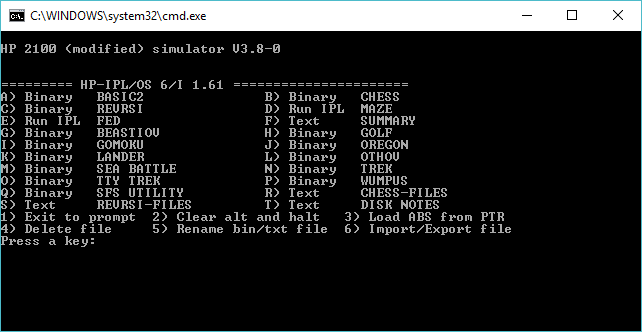
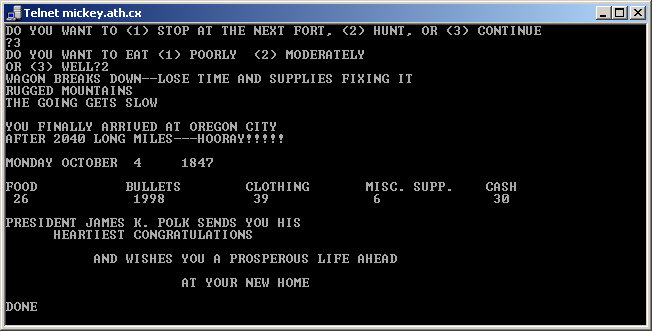
I had just found out that the Oregon Trail game is a LOT older than the Apple II version that infested schools in the 1980’s and gave us the infamous broken axle. As a matter of fact it was first written for the HP 2100, in BASIC.
Yes the computer was the size of a wagon!
There is a most excellent blog, The Digital Antiquarian that goes over the restoration of this old gem.  Even better they managed to get it loaded up onto a timesharing image, on the internet so you can play it! (it’s been since taken offline. sorry).
1. Telnet to mickey.ath.cx. (Telnet, mind you. None of that newfangled SSH!) 2. Slowly alternate CTL-J and CTL-M until you see a “PLEASE LOG IN†message. 3. Enter “HEL-T001,HP2000,1″. Without the quotes, of course — and note that those are zeroes. Oh, and the system isn’t case-sensitive, but for the authentic experience you might want to have your caps lock on. 4. Enter “GET-OREGON†to load the 1975 version, “GET-ORE2″ to load the 1978 version. 5. “LIST†the program if you like, or just “RUN†it.
Good lord like things could possibly look any worse!
The end of humanity
I don’t know what even overcame me as I read the news on thinkq, but I’m already thinking of backing out. LOL Â But it’s now “free” to people for the first 20 levels. Â But who would want to quit at level 20 and not go all the way to 87?
Personally, I couldn’t care less about Terraria, although it reminds me a bit of Zelda III back in the day, but it does have this multiplayer capability. Â But it never mentions the TCP port. Â Well the default port is:
7777
And if you have an Apple airport network, a teenager that needs to have ‘cut off times’ and sits 2 levels of NAT in, you’ll have to forward TCP 7777 all the way to their computer. Â It’s not the end of the world but UPNP doesn’t work in nat-nat scenarios (thankfully) but the blasted game doesn’t mention when setting up a network game, oh by the way you’ll need to NAT TCP 7777.