February 29, 2012: updated for Qemu-1.0.1 – Still a “to be tested” version. See bug report win32: git rev 59f971d crashes when accessing disk (coroutine issue). In my version a workaround was to compile coroutine-win32.c without optimisation (-O0): contains qemu-system-arm.exe, qemu-system-i386.exe, qemu-system-ppc.exe, qemu-system-sparc.exe, qemu-system-x86_64.exe and the linux-0.2.img image
Well isn’t that amazing… I know I’d given up on it as as soon as some OS’s accessed the hard disk once they’ve initialized in protected mode it’d just lock up…
I may well have to revisit my Win32 builds of Qemu 1.0.1
Well I’d say it was a few simple reasons. First the internet in 1983 was a very limited ARPANET, which was a big deal for an institution to get onto, let along an individual.
In the quick Slashdot post, they go on about the Viewtron service offered by AT&T. And why did it not become such a major success, where the internet trumped everything?
Its quite simple, nobody likes a walled garden. You can bet that AT&T wouldn’t allow people to just spout off their opinion wherever on their network. Even today there is a limit on what you can say on corporate networks, and on corporate systems. The big thing about the internet is that anyone can not only register a domain, but easily get access to server software and become their own ‘site’ on the internet independent of what large corporations may think, or wish.
The other thing to remember is the state of personal computing in 1983. While the rise of personal eight bit computing, there was no ‘open’ networking standards on which to build large scale networks. Because everything had to be licensed, and people were expected to pay big money for those technologies, people (hackers!) ended up writing them on their own. Even the mighty internet today is more so because of hackers, and not from major corporations. And fill the gap they did with what limited systems were available with BBSes and FIDONET.
What about UNIX?
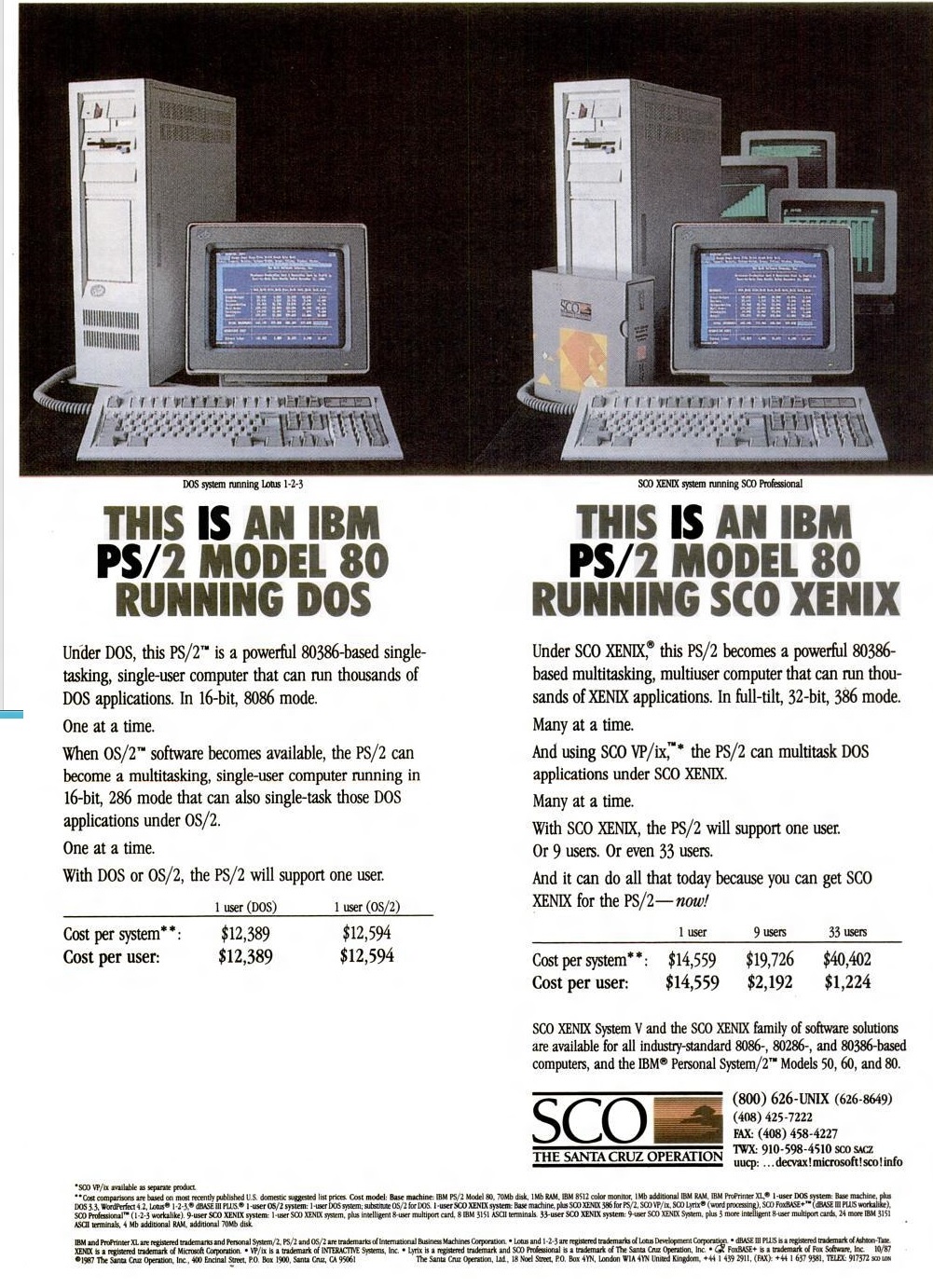
While UNIX was a popular OS and the hackers dream, in 1983, getting a PC to run UNIX was a BIG endeavor, as the hardware was super expensive, and licensing was very restrictive. The big ‘player’ of course was Microsoft via SCO with Xenix. For example in 1983, an Apple Lisa was $9,999. And Xenix could easily set you back some $2000 for the OS alone.
Even by 1987 a decent Xenix machine could still set you back some $15,000! That would be $27,567.45 in 2010 dollars! And that is just a ‘runtime’ machine, no STREAMS, TCP/IP, and NO COMPILER!
$14,559 for UNIX in 1987!
This of course raises me to the next point about the lack of affordable 32bit general computing in 1983, and software. Even at the university level the kind of machine that was going to be connected to the internet was a massive ‘mid’ range machine like the VAX 11/780 running BSD Unix. Even back then BBN was trying to get its proprietary TCP/IP stack into a ‘base’ UNIX, which would further encumber the distribution of UNIX, while Bill Joy freed us all by providing BSD 4.2, and licensing it for free with only four clauses to be redistributed, and altered at will. Which was fantastic, but the hardware requirements vs what anyone could buy off the shelf was.. a massive gulf. While a VAX with 8 MB of ram, a 500MB disk, and an Ethernet adapter (which was again an open standard) would cost several hundred thousand dollars, the 68000 chip from Motorola was changing everything, and was democratizing network stations first with Apollo, then with SUN.
Heck even SUN was founded on trying to bring BSD 4.2 to the masses, and the SUN-1 didn’t even run BSD UNIX but rather a UniSoft port of UNIX v7. Even from the business plan, the expected price at retail was $7000.
Of course as good as the hardware was getting “affordable” where a workstation would cost as much as a mid level car, the software however was *NOT* free. This is where Richard Stallman stepped in with the FSF, and started to replace piece by piece all the software on SunOS with free & open equivalents. It wasn’t until 1991 that there was enough GNU/Free software from that end to even start to bootstrap a free system (Linux). Even the BSD people with their NET/2 release wasn’t ready until 1991 as well.
In addition take a look at this computer from 1991:
It is comparable to the $14,500 IBM PS/2 model 80, but at $2,295 it is something that the average user could afford. And even in 1991 there was the beginnings of free & Open UNIX via Linux & 386 BSD to run.
So as you can see with the rise of affordable 32bit computing, open software with open networking standards in software and hardware that made an open network prevalent.
As we move into the future the larger question to me is, are people going to accept the big networks trying to turn the clock backwards to these ‘gardens’ where you must obey your corporate owners, never speak ill of them, and live with all the censorship.. I still believe that what made the internet unique is that not only could you participate in a global network, but you could with little investment become part of it. Just as someone like me who had an issue with blogger being down for a protracted amount of time, was able to take my content and host it myself. Something you cannot do in the walled garden of networks.
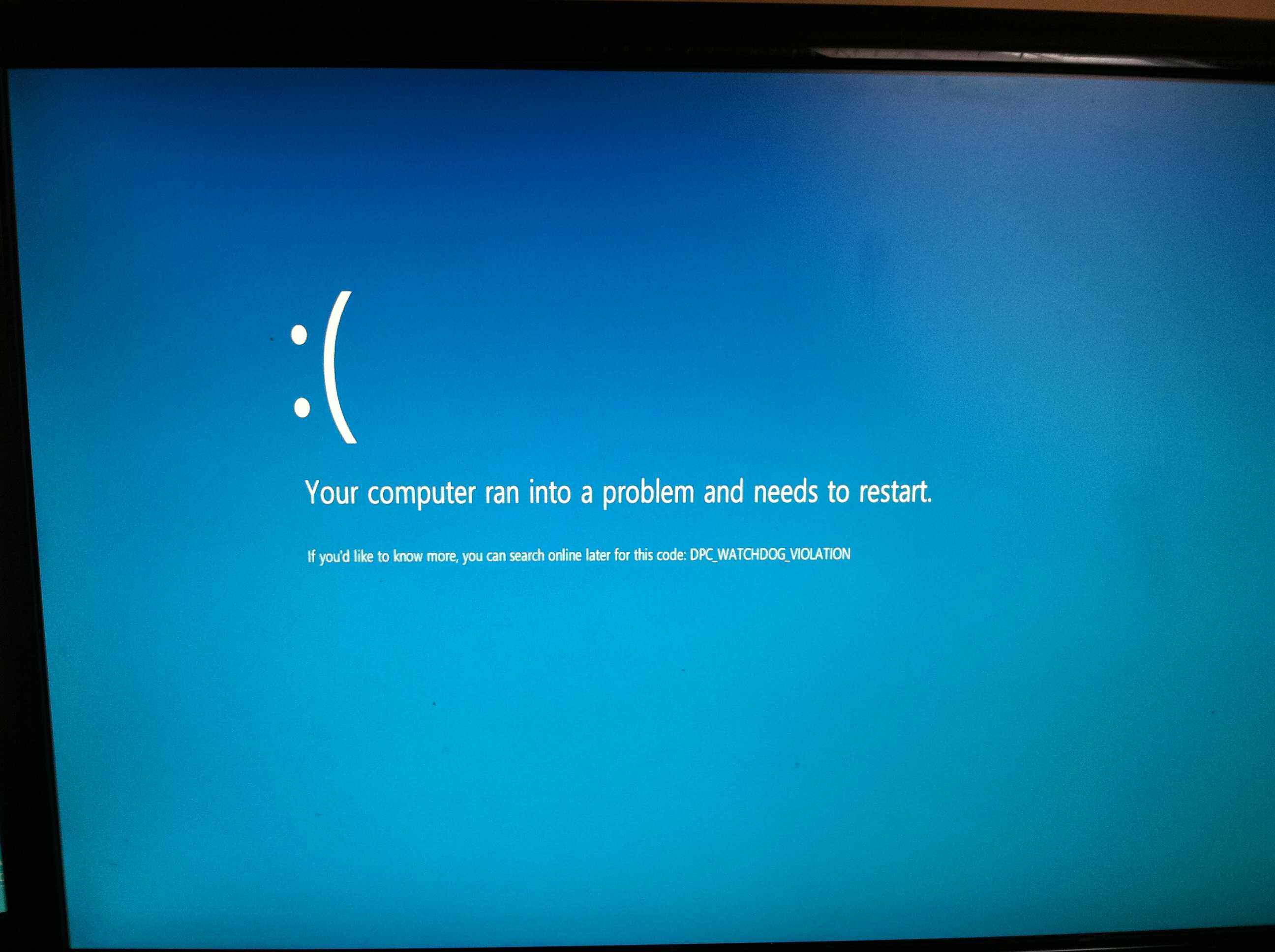
I don’t know what has been going on but my PC has been acting weird. Â Windows 7 didn’t do squat to even help to identify what on earth was going on, but now I guess the hint is DPC_WATCHDOG_VIOLATION
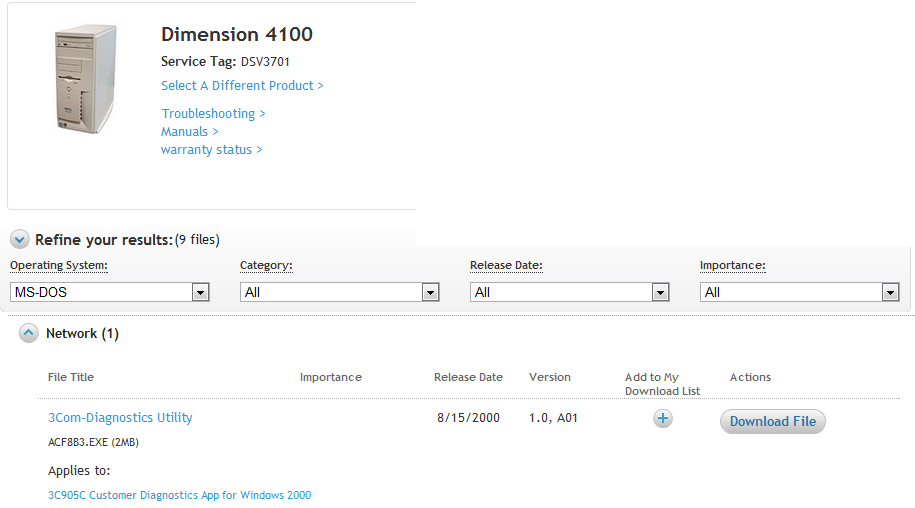
So I’ve been talking with Frank Sapone about recovering old data and how I’ve had the worst luck with old 3 1/2″ disks. Â Even sealed stuff like the MS-DOS client components of SQL Server 4.21a which Microsoft chose not to put on the CD-ROM, but rather on floppy diskette … which are not readable.
What is surprising is that not only has he had the same luck with 10-15 year old 3 1/2″ disks, but with 26 year old 5 1/4″ disks is that he can read them fine.
That is right, 26 year old  disks work fine with a good Panisonic 5 1/4″ drive mechanism, including a box of random disks he bought on e-bay that went through the old fashioned metal scanners, that he thought at best was a bulk lot of junk, he could read 100% of them with no errors.
I can only wonder how many people are sitting on ‘good media’ still factory sealed to only find out they are completely worthless.
If you’ve got old stuff, you better read it NOW… Otherwise it’ll probably never work, esp if it is 3 1/2″.
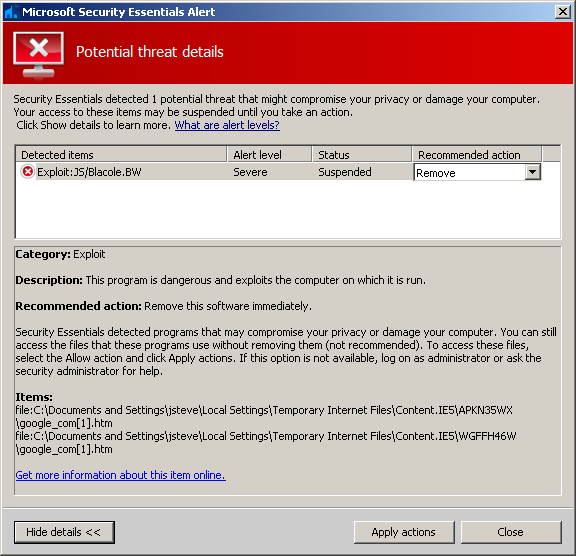
So I log onto an older XP VM, hit google, and blamo,  Google Exploit:JS/Blacole.BW .. What on earth is that? is google infected…???
So it seems this is just a false alarm, update your definitions and it’ll take care of the ‘problem’ …. But you have to wonder is there really someone on google, that MS forgot to whitelist..? Â Much like how antivirus / spyware products will not show you government spyware…
While talking to a friend we were mentioning how the lifespan of tapes really sucks, how you could have some tapes that easily surpassed their lifespan of seven years, while some couldn’t last seven weeks. At some point in the business we’ve all seen it, some poor guy runs the local server backup to tape every night, they have a disaster, they call everyone they know for the tape backup program & OS as they’ve never tried to do a recovery before, and then you find out that the backups are all bogus because they forgot to format the tape, or some other nonsense and all the tapes are blank… They’ve never actually read the output of the backup program to know that they’ve backed up nothing.
At least we were able to send out the disks for repair and got back the vast majority of the data, but having the false assumption that they had good backups is the worst.
In the picture the idea is that the single DAT tape can hold the capacity of all the other tapes, but tapes are not only picky creatures, they can easily break giving you gaps in your data…
IMHO the only ‘workable’ backup is to hard disk, and those should be mirrored… Don’t use USB or ‘consumer’ grade stuff, those disks wont last five years let alone 30… And keep getting new disks and copying stuff up. Â Sigh.
As easy as it is to watch everyone get locked out of new ‘cloud’ based software, it is just as easy  to get locked out of old stuff.  Make ISO images of your CD’s just in case.  Keep text files of your license information, email it to yourself!  It is far too easy to get locked out.  And as vendors move on, all they’ll sell you is new stuff that very well won’t work with your old data.