Some random updates…

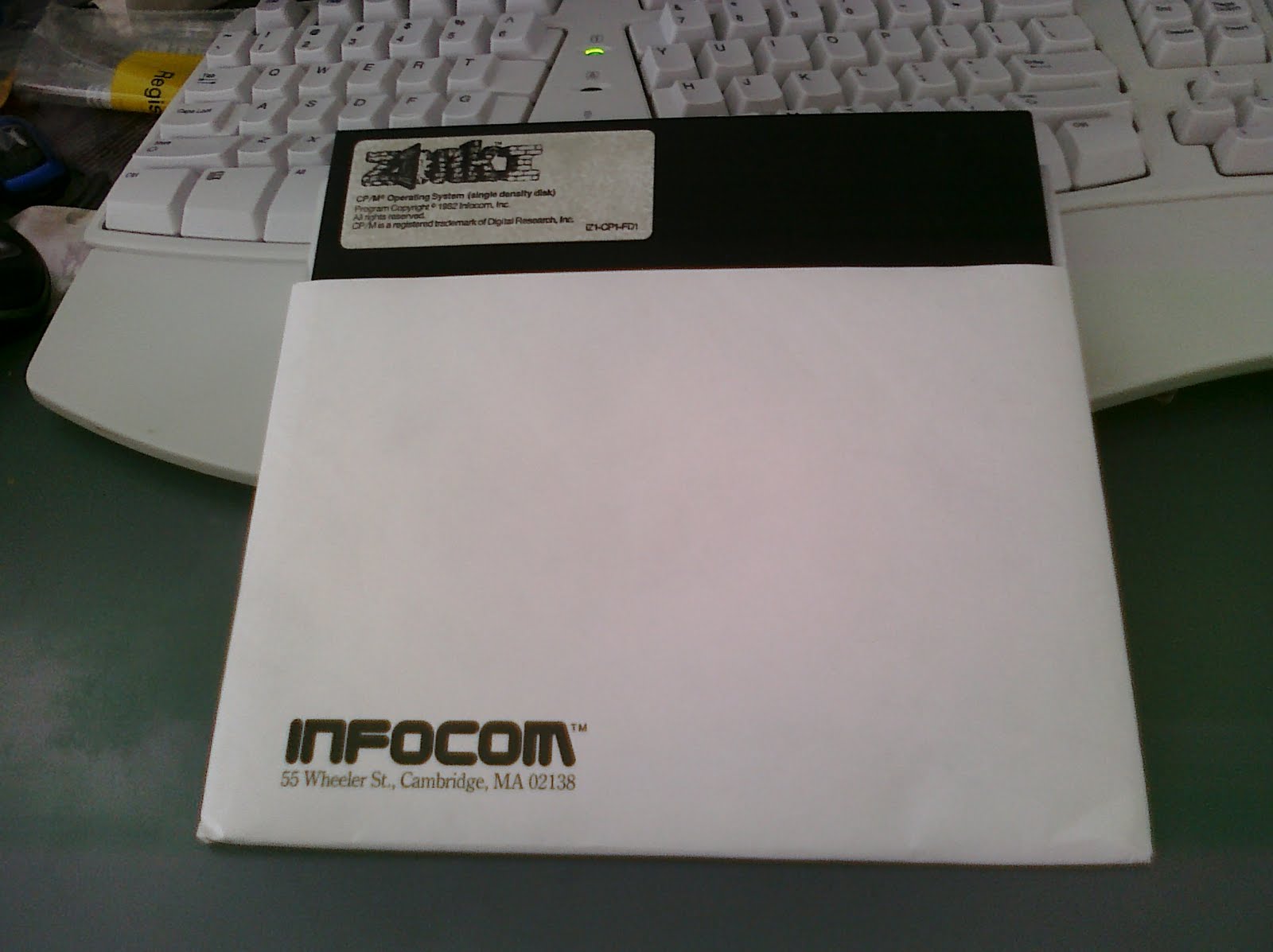
I just got back from a trip, so here is a quick shot of the 8″ diskette of Zork 1 for CP/M… I put it against my keyboard for some sense of scale.. It’s MASSIVE.

Zork 1 on an 8" floppy disk

Zork 1 on an 8″ floppy disk

I also found this Infocom interpeter written in Turbo Pascal, written by Martin Korth. It was written for Turbo Pascal 4.0, but I’ve built it with 5.5 and 7.0 without issues.

A friend of mine pointed me towards this new emulator PCE that looks very promising.. It boots off real IBM ROMS! Right now it’s 8086/80186 capable, but it’s still VERY cool.

Word is the author is working on Sparc32, ARM & PPC emulation… It looks very cool.

Thats about it for me!

Some more random stuff.

Well while I was playing with NeXTSTEP on my P4, I managed to screw up the BIOS settings… The sound card I have is the AWE 64, one of those great ISA Plug & Play cards. The crazy thing is the only way to configure it properly is with a Pnp capable OS..

But back in the day, you could configure these things under MS-DOS with the ICU, or ISA configuration utility.. Which has become nearly impossible to track down, but I did manage to find a copy from Dell ICU-143N.EXE. It’s a bit crazy to setup, but once you go through the motion you can setup the IRQ dma etc etc, and with one more bit of ‘trickery’ on the nextstep pnp sb16 driver it’ll work. Naturally mine needed a different hex code 0x08ec009d

phew.

With that out of the way, I found another program for the NeXT, str a port of a SUN mod player.. Oddly enough it’s too slow to run on my m68k next cube, but it runs great on my white box now that I’ve managed to run the thing. At least it’ll be some kind of starting point for audio for Quake.

In other news Artyom managed to get Solaris 2.3 installed & running on Qemu.

I know people wanted me to go over AIX for the pc, but it tends to corrupt itself like crazy, however I got a tip that if you boot from floppy all the time, then have it mount the hard disk as multi user it doens’t freak out with hdintr issues…

That’s about it for today.

NeXTSTEP audio & mod files…

Well I’ve been looking for a way to get some audio out of Quake for NeXTSTEP… and it’s incredibly complicated. I found some ‘smallish’ program for the m68k black hardware that is a MOD player, modPlayer 2.5 which also included source!

However, for me I can’t run it as the monitor to my cube is busted… But I was able to compile it to verify the source ‘works’. I then built it on my white box (P4 2.4Ghz 1GB of ram, and a real soundblaster 16!) and, after removing the reference to the decrunch routine it produced.. noise, and lots of it. But I did feel like I was getting *somewhere*.

I figure the main reason it’s exploding is that the m68k port uses the same CPU as the Amiga for these MOD files, so no doubt there is some bit flipping needed to go from big endian to little endian, but I know *nothing* about the MOD format.. So after a quick google search on basic mod players, I found qmod, a module player written in Quick Basic!!

So I looked around for a copy of Quick Basic 4.5, and tried to build the program, and it was all crash & burn.

At work we have a copy of PDS, the Professional Development System, also known as Basic 7.1 .. This thing is still useful, it will target OS/2 so you can write these massive programs (and run them under Windows 2000). So I figured I could use that to get the thing to build.. And I ran into the same errors about overflows, and all kinds of crap.

So the next thing to try was a copy of Visual Basic 1.0 for DOS that I got from ebay a while back.. I made images of the disks, which was fun, installed the thing to get.. the exact same errors. But I have to say VB for DOS was cool in that the output window can be in a windows (although text one) and you can trace and see at the same time… If only this was on store shelves in 1992!!!!

Anyways after looking at the command line options for VB for dos, I spotted this…

/Ah Enable huge dynamic arrays

I was surprised! So it would seem the answer was in the compiler, not the nice interface.. I just has ‘assumed’ that the interface would provide all the options.. Not so.

So I re-extracted the qmod source as I’d hopelessly altered it, then ‘fixed’ the one line that prevented compilation…

DEF SEG = VARSEG(mixarea(0))

I just removed that line, and ran the compiler & linker.. and it runs!

C:\TEMP>bc /Ah /O qmod.bas

Microsoft (R) Visual Basic (TM) for MS-DOS (R)
Compiler – Professional Edition Version 1.00
Copyright (C) 1982-1992 Microsoft Corporation. All rights reserved.

Object Filename [qmod.obj]:

Source Listing [nul.lst]:

42555 Bytes Available
33278 Bytes Free

0 Warning Error(s)
0 Severe Error(s)

C:\TEMP>link qmod.obj

Microsoft (R) Segmented Executable Linker Version 5.31.009 Jul 13 1992
Copyright (C) Microsoft Corp 1984-1992. All rights reserved.

Run File [qmod.exe]:
List File [nul.map]:
Libraries [.lib];
Definitions File [nul.def]:

C:\TEMP>

Now this program does require a sound blaster card, and it also requires the blaster environment variable set properly… So for Virtual PC it’s simply

SET BLASTER=A220 I5 D1 H5 T4

Then run qmod and the supplied mod file, and away it goes!
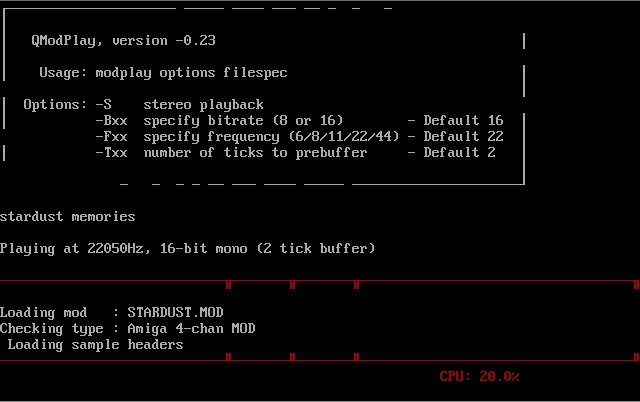
Qmod under Virtual PC

Qmod under Virtual PC

And I have to say it’s really cool to listen to this thing work, only using peek/poke (ok it’s inp/out in the new syntax…) but it’s playing the soundblaster, and it sounds GREAT.

So going back to PDS & Quick Basic 4.5 they all support the /Ah flag.. So it’ll build on any of them.

So for those who aren’t inclined to play compiler games, here is a pre-built version of Qmod, and it includes a mod file.

Now for those of you who don’t have Virtual PC, or not running on Windows, the program will run on DOSBox as well!

I just found I had to tweak the cpu config a little to make it run.. This is my CPU block in the configuration file.

[cpu]
#core=auto
core=simple
#cputype=auto
cputype=486_slow
cycles=auto
cycleup=500
cycledown=500

Now when you launch DOSBox, it’ll pick some low cpu cycle number and stay there when you launch qmod.. And it’s too low so it’ll sound horrible. So hitting CTRL+F12 will increase the cycles. Set it to 25000, and it’ll run fine. If you set it too high, CTRL+F11 will bring it down. DOSBox already sets the blaster environment variable for you, so it should ‘just work’.

From there I’d recommend sites like Amiga Music Preservation, or Mod Archive. Qmod can play quite a few of the files with the MOD extension, but not all.. But it’s a great small example program.

As luck would have it, my whitebox is having some weird boot issue, so I can’t go any further on this… But I figure I’d share this much with the world…

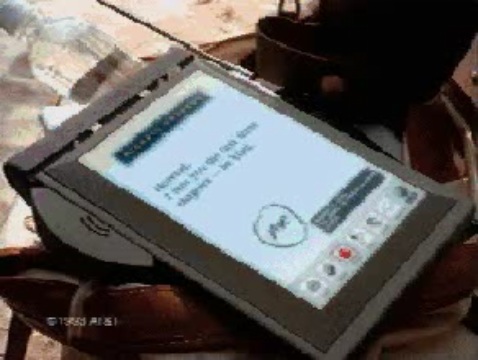
The old AT&T "you will" ad campaign

So while I was looking at an iPad for no real reason, something told me I’d seen this thing before…. Something familiar..

iPad from the 1990s

iPad from the 1990s

Then I remembered this old thing.. The old AT&T you will from the early 1990’s.

The killer in retrospect, is that in the early 1990's most people were lucky to have pagers, cellphones were bulky and cost prohibitive (lol nothings changed there), I went from a regular pager, to a 2 way pager, then to a nextel, then to a Motorola startac..

Ok, it's not emulation, but it really is funny to see these future forward things, and how much we take for granted now, and just how... different things changed.

Visual Studio 2010 just shipped

So many editions!!… I’m already confused. I think this is the last version to support the Itanium, as that platform is basically cooked.

Considering how lackluster and scarce they were at the launch I guess it’s not surprising.

Anyways It’ll be nice to fire up the x64 CLI tools, and not be told that the ‘release’ is infarct a beta…

Anyways, there is some details over at the MSDN site.. And a demo/eval download.

On the ‘cheap’ front, the express editions are also updated to the 2010 level. I’d recommend getting the ‘offline’ ISO image… That way you’ve got all the bits in one shot.

On the UNIX front, I found that on OpenSolaris, that the SunStudio is a free download. This includes SUN’s C/C++/Fortran (77/90/95) compilers.

I took a quick look at the SUN F77 compiler, and it’s certainly the UNIX one from the days of v7 as it behaves the same way… I guess that’s not too surprising.

Other then that, not a heck of a lot going on.

gzip for Xenix

sorry I didn’t realize that IIS was blocking the gzip download because of it haveing no extension…

I really need to redo that whole install.

Meanwhile you can download it here:

gzip-i386-xenix

Also I found on some old “Soviet Union” website (no really it’s a .su!) a binary version of GCC for Xenix… I’ll post more later as I get a chance to go through the thing….

For the adventurous it’s here:

ftp://ftp.kiae.su/pub/unix/os/xenix/gnu/  (now offline)

It’s kind of interesting to find such a thing, and if you see the dates, it’s from January 28th 1991… In the last days of the Soviet Union… Well lucky for us, someone in Russia is a packrat! I guess they were starting to switch out from homemade PDP-11’s into 386’s and they didn’t bother porting their ‘pirated’ versions of Unix v6…

While on holiday, I had some access to a PowerPC mac

so I’ve made some builds, of stuff…

Starting with f2c:

http://vpsland.superglobalmegacorp.com/install/f2c/

This built pretty straight forward, and it’s not that crazy CPU intensive so I would imagine it’d run fine with the rosetta code on OS X i386…

I’ll have to make some more cpu/os builds as it’s a fun test….

The second thing I built was some SIMH binaries, but they would be SLOWER on i386 mac’s then the PowerPC stuff… Hopefully someday I can have intel Mac access….

Anyways I’ll have to upload those later, so I’ll just post back….

ML648s & video files…

So I got one of these ML648s video players for christmas. And it says it’ll play WMV/WMA files so it seems to be pretty straight forward to convert stuff right?

Wrong.

Right now I’m taking the output from handbrake and passing it through AMV convert then copy it to the device from windows explorer and you are good to go!

It’s a shame they didn’t write on the box, that it needs this AMV format thing….

But after a LOT of googling around here is the solution.

Polling around….

This weekend has been kind of crappy as we had some cisco switches flake out, but nobody knew anything happened… I’d been pulled away on so many things over the last few years that monitoring them kind of fell by the waaaayside.

Well in this economic environment nobody is going to shell out tens of thousands of dollars for some simple syslog/polling system that pages people. I needed one for free.

And years ago, I wrote a simple one that revolved around SQL Server 7/MSDE 1.0

Anyways I’ve made it as 2 CD images, and if you are bored, or in the need to poll devices with a basic TCP connect you can download it here:

https://sourceforge.net/projects/simplemssqlnetw/

What may be useful for people is that I’ve put some impossible to find software on the prerequisite CD…

Namely:

NT 4.0 sp6a
MSDE 1.0
Option Pack (IIS4)
SQL 7 sp4

For some reason all the above stuff is getting dammed near impossible to find on Microsoft’s site. I guess it is end of the road for the NT 4.0 heyday. So at the least, this is my way to keep a location to download this software, as I’m sure someone will need it someday.

MSDE 1.0 for those who don’t know was a redistributable version of SQL Server 7.0 that had a 10 user limit, and a 2GB database size limit. Also there was no GUI management but it was great to use, because unlike SQL Express, it included the SQL Agent. The agent can run tasks at certain times, say like run a TSQL script that dumps a list of machines from a table into the hosts file, then tries to connect to each machine and record the state into a database…..

It was VERY useful stuff for the time.

There is no exciting screnshot, as I never did make an interface to the thing, instead I opted to configure everything through Access.

Other then that, I’ve been playing with a BackOffice 1.5 CD set I got on ebay… NT 3.51, MS Mail 3.5 & SQL 6.0!! It’s been so long, but MSSQL 6.0 was the first SQL server that I ever was payed to manage… It’s amazing how far we’ve come as an industry, and at the same point how things stay the same, although the installation of NT 3.51 is SO FAST!!!

Some updates..

I had a request for the qemu 0.90 binaries to run NeXTSTEP… I don’t own Vaxenrule.com anymore so for now I’ll put them here:

http://dl.dropbox.com/u/1694005/qemu090%20for%20nextstep.zip

Sorry for the bitrot stuff… 😐 At least I’m still here.

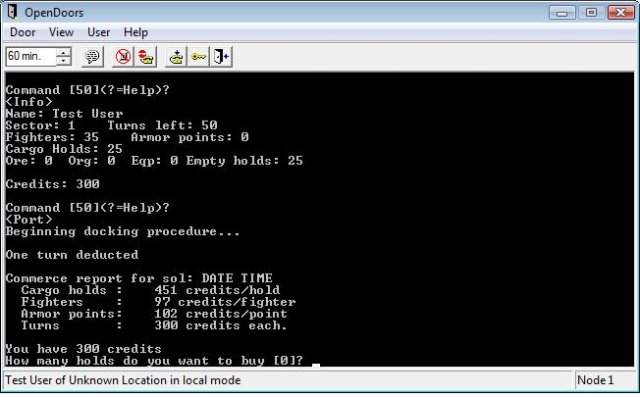
Also while working on Tradewars C today, I came across this great package called OpenDoors. Even better is that it’s under the LGPL. The only “downside” is that OpenDoors requires Visual C++ 6.0 or higher to build, because of the toolbar.. Also I’m not sure if going from VC 1.0 to 9.0 didn’t flake some stuff out as well… I’m not 100% sure about it, but the trading part of the game feels.. weird.

The examples are pretty straight forward, and it took a few hours on & off for me to convert the standalone tradewars into a door program. I like the feel of it so much I may try to see about converting SIMH to run with it.. Maybe even dumbfrotz.

OpenDoors trade wars

OpenDoors trade wars

Above is a picture of what the console looks like.