
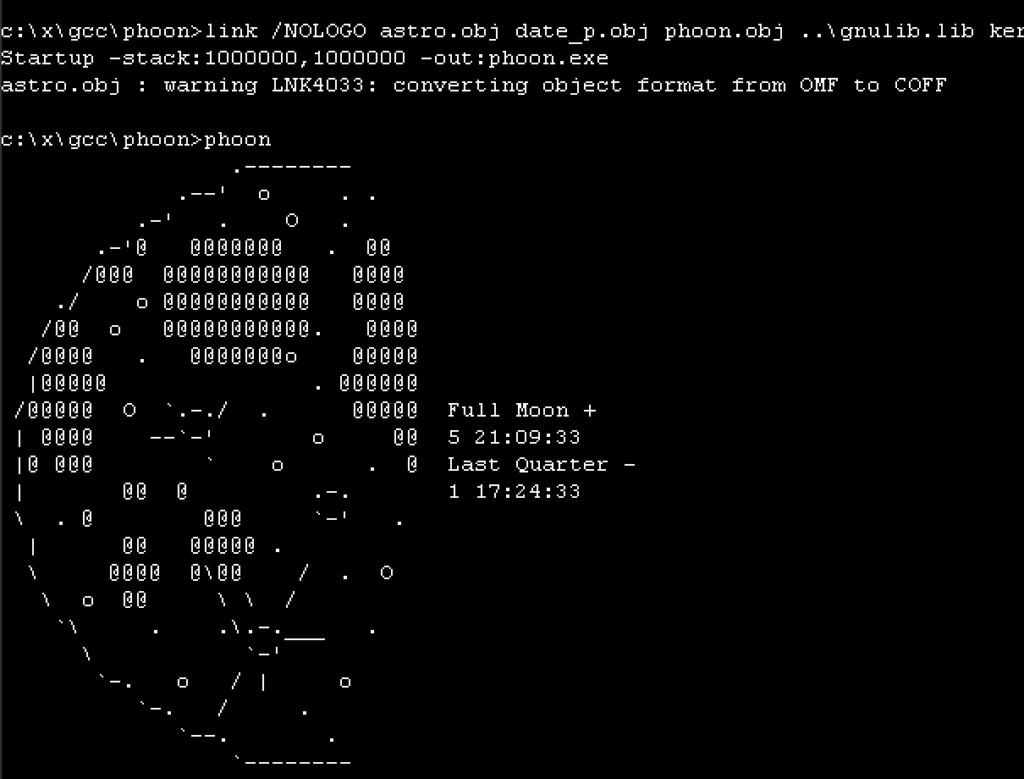
Oh sure I’ve done this ages ago, getting GCC 1.40 to compile with old Microsoft C compilers, and then target Win32, it’s not that ‘special’. But I thought I’d try to get them to build with MASM so I could just distribute this with an assembler. Spelling out the joke of some assembly required.
Although I wasn’t going to target/host OS/2 I was ideally going straight to Win32, the MASM 6.11 assembler couldn’t assemble the MSVC 1.0 / MSC/386 8.0 compiler’s assembly output, I needed to use the MASM 7 from Visual C++ 2003; namely:
Microsoft (R) Macro Assembler Version 7.10.3077 Copyright (C) Microsoft Corporation. All rights reserved.MASM 6.11 was having issues with pushing OFFSET’s ie:
push OFFSET _obstackwhen they were defined as:
COMM _obstack:BYTE:024HChat GPT to the rescue knowing that later MASM’s will just handle it just fine. And it was right! I know AI gets a bad rep, but surprisingly (or not when you think about what it’s been trained on), it’s got some great insight to some old things like seemingly common software tools, and old environments.
I didn’t bother trying to use Microsoft C/386 6.0 & MASM386 5.1 to see if it’ll handle CC1, as that seems to be a bit extreme. and I wanted this to run on semi modern Win32 stuff. More so that there isn’t a 64bit SMP aware OS/2 with a modern web browser. Kind of sad to be honese, but it’s 2026, and here we are.
I as always stick to the Xenix GAS port that outputs 386 OMF objects that earlier linker’s can happily auto-convert to coff and use on Win32. One day I feel I should ask why they were cross compiling NT/i386 from OS/2 1.21 instead of using Xenix?! Must have been some fundamental NTOS/2 thing I suppose.
I guess a refresher for anyone comming in out of the cold here’s a really poorly done block diagram of what goes on when a traditional (GCC) compiler runs. Explaniation is here: so it turns out GCC could have been available on Windows NT the entire time.
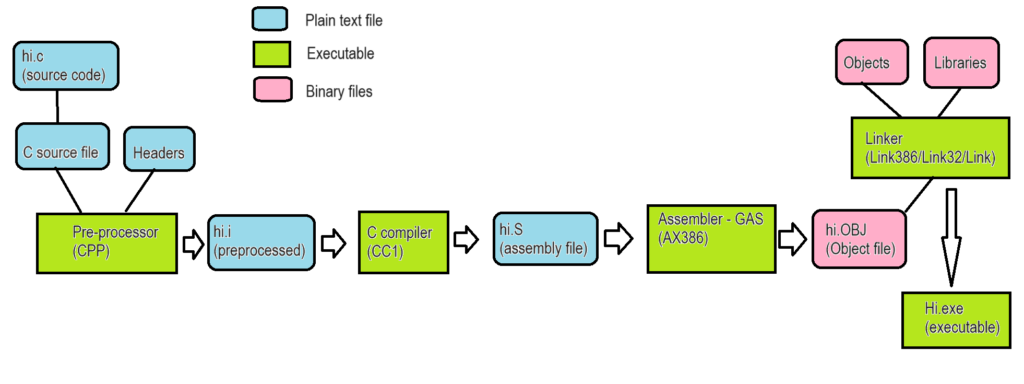
Long story there was that the Xenix GAS emits an ancient 386 OMF format that for unknown reaons the older Microsoft Linkers happily accept and auto convert into COFF, the file format of the future (Future being 1988). I guess for better. or worse we never got NT/ELF. Oh and speaking of further weird, the IBM version of their LINK386 doesn’t like the Xenix 386 OMF. Bummer.
One thing I found out is that the MASM v7 doesn’t output COFF by default, rather it’s 386 OMF! you need to add the /coff flag to force it to be more Win32 friendly. Kind of unexpected behaviour.
I tried to make this simple as, clone the repo and run ‘build.cmd’ it’ll link up GCC and then build the test programs, and clean up after itself.
https://github.com/neozeed/gcc140-masm
I’d tried to emit assembly for the Xenix GAS, but for some reason it’s struggling with floating point. I’m not sure, I tried using chat gpt to debug but it get’s confused on how this whole bizzare tool chain is working. I guess I can’t blame it.
Sorry it’s been a while, been feeling ‘life’ lately. I had some i7 project as a kicker for a retro Windows 10 build thing to do but watchign the RAM crissis unfold and well life… I just got feeling like it’s so irrelevant who’d care. That and it’s insane watching $1.11 worth of DDR3 RAM now selling for $30++ …. and more and more chip manufacturers are exiting. So it felt like maybe go back and do more with less. Even a low end machine can assemble this in seconds!